🔍 The Used Pontoon Weekend-Killer Guide: 27 Things to Check Before You Buy
Used pontoons that look perfect on the surface hide the most expensive surprises underneath — corroded welds, water-filled logs, and electrical systems held together with hope. Forum members call these hidden defects "weekend-killers" because you discover them on your first real outing, and your summer plans die right there at the dock.
This checklist is built from the exact problems that experienced owners and marine surveyors flag most often. Every item comes from real failure data — Reddit threads, PontoonForums archives, and marine service reports. As experienced owners advise on r/Pontoons, knowing what to inspect is the difference between a great deal and a money pit. Check all 27 before you hand over money.
⚓ Logs & Hull — Items 1–8
The pontoon logs (tubes) are the most expensive component to repair or replace. A log with internal water damage can cost $3,000–$10,000+ to fix. Start here.
Rock the boat side to side on the trailer. Listen for water sloshing inside the logs. Any sloshing sound means water has breached a weld seam, drain plug, or tearaway pad. This is the #1 most expensive hidden defect in used pontoons. Full swooshing sound diagnostic →
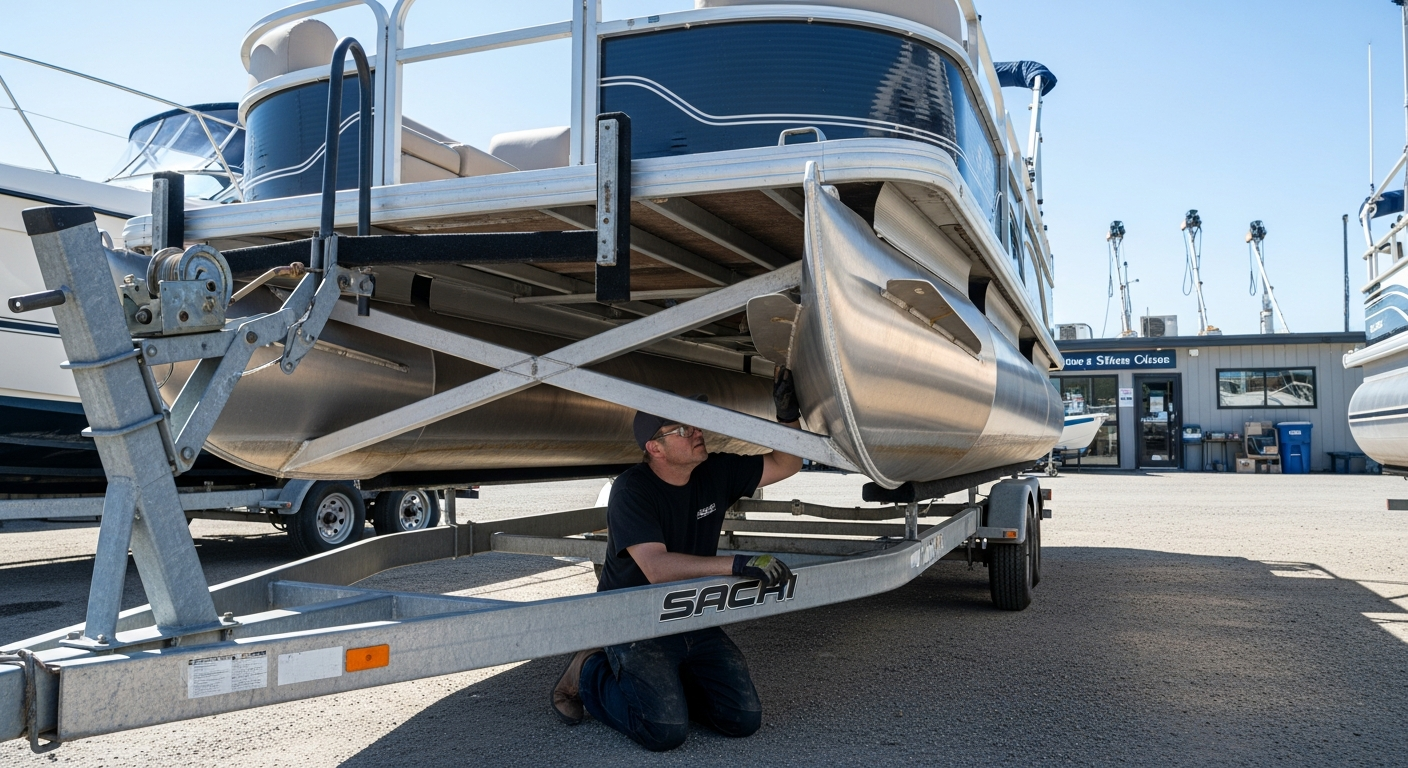
Look underneath the boat at every point where a bracket or component attaches to the logs. Tearaway pads are welding shortcuts — small aluminum pads welded to the log as mounting points instead of full continuous welds. They crack over time and create leak paths into the log. Freshly painted logs are a red flag — sellers paint over tearaway pad cracks. Detailed tearaway pad guide →
Every log has one or two drain plugs at the stern. Check that plugs are present, not cross-threaded, and not corroded into the bung. Remove one plug and check for water drainage — any water coming out means the log has been compromised. The threads should be clean aluminum, not corroded or stripped.
Sight down each log from stern to bow. Logs should be straight and parallel. A bent or bowed log indicates impact damage (grounding, hitting a submerged object). Minor dents in the nosecones are cosmetic. A visible bend in the main tube body is structural — walk away.
Run your hand along the weld seams on the underside of each log. Good welds are smooth, continuous beads. Bad welds show gaps, porosity (tiny holes), or cold lap (where the weld did not fully fuse). Pay extra attention to the nosecone welds — this is where impact stress concentrates.
Crawl under the boat and inspect the aluminum cross-members that connect the logs to the deck frame. Look for cracks at the weld points, excessive corrosion, and any signs of repair (mismatched aluminum, grinding marks, re-welded joints). Cross-member failure is catastrophic — the deck separates from the tubes.
Most pontoons have zinc or magnesium anodes bolted to the underside of the logs for electrolysis protection. Check that they exist and are not completely consumed. Missing or fully dissolved anodes mean the logs themselves have been sacrificial — absorbing electrolysis damage that the anodes should have taken.
If the pontoon has performance strakes or lifting fins welded to the logs, check that they are straight and firmly attached. Bent or loose strakes create drag, reduce performance, and indicate possible grounding or trailering damage.
🛋️ Deck & Furniture — Items 9–14
Furniture replacement is the second most expensive repair on a pontoon — full reupholstery runs $5,000–$10,000+. Check thoroughly.
Squeeze the seat cushions hard. If the foam feels crunchy, stiff, or doesn't spring back, the foam has absorbed water and is deteriorating from the inside. Simtex (a lower-cost vinyl alternative) is especially prone to this — it allows moisture through seams faster than marine-grade vinyl. Three seconds of squeezing tells you if you are looking at a $500 cleaning job or a $10,000 reupholstery nightmare.
Lift every seat base and look underneath. This is where sellers hide problems — mold, rot in plywood seat bases, corroded mounting hardware. Plywood bases in older pontoons absorb water and delaminate. Aluminum bases are better but still need hardware checks.
Pull up a corner of carpet near the stern (where water collects). Check for mold, mildew, or rot in the decking beneath. Snap-in marine carpet and woven vinyl flooring are replaceable ($800–$2,000) but the underlying deck damage they hide is the real concern.
Open and close every gate. Latches should click securely. Hinges should move freely without binding. Worn gate hardware is cheap to replace ($20–$50 per latch) but indicates overall wear level and whether the boat has been maintained.
Grab each railing section and push firmly — sideways, forward, back. Railings should feel solid with zero play at the base mounts. Loose railings mean corroded mounting hardware or cracked base welds. This is a safety issue, not cosmetic.
Check the bimini frame for corrosion at joints and hinge points. Aluminum frames develop white pitting that weakens the structure. Check the canvas for UV damage, mildew, and stitching integrity. Budget replacement: $200–$400 for canvas, $600–$900 for a stainless frame upgrade. Stainless bimini upgrade guide →
⚡ Engine & Drivetrain — Items 15–20
Check the hour meter. Pontoon engines under 500 hours are low-use. 500–1,000 hours is moderate. Above 1,000 hours, engine condition depends entirely on maintenance history. No service records = assume the worst. Ask for oil change receipts, impeller replacements, and winterization records specifically. Owners reflecting on what they wish they had known consistently rank service history verification as their top regret when skipped.
Ask to see a recent compression test or request one before purchase. All cylinders should read within 10% of each other. One low cylinder may indicate a worn ring or valve issue. Two adjacent low cylinders suggest a blown head gasket. This is the single most informative engine diagnostic for the price (a mechanic charges $50–$100).
Check the lower unit gear oil by opening the drain plug over a clean paper towel. Clean gear oil is clear or amber. Milky white oil means water intrusion through a failed seal — a $500–$1,500 repair. Metal flakes in the oil mean gear damage — potentially a $2,000+ rebuild.
Inspect the propeller for nicks, bends, and missing material on the blade edges. A damaged prop creates vibration that wears shaft bearings and hub components. Replacement aluminum props run $100–$200. Check whether the current prop size matches the engine rating — an undersized prop may indicate a seller trying to compensate for an underpowered engine. Check correct prop sizing →
Turn the wheel lock to lock. It should move smoothly without binding, clicking, or dead spots. Hydraulic steering should hold position without drifting. Cable steering should not feel gritty or stiff. Check for hydraulic fluid leaks at the helm and at the engine tilt tube.
Check fuel lines for cracking, hardness, or swelling (ethanol damage). Inspect the fuel tank for rust (steel tanks) or deformation (plastic tanks). Sniff the fuel filler — stale or varnished-smelling fuel indicates the boat sat without stabilizer. Check the fuel/water separator filter housing for corrosion. If the boat sits low in the back, an oversized or overfilled fuel tank may be the cause →
🔧 Electrical — Items 21–24
Electrical problems are the most common "weekend-killer" on older pontoons. Forum members call bad wiring jobs a "rats' nest" — and for good reason.
Check battery terminals for corrosion (white/green buildup). Check battery date codes — marine batteries last 3–5 years. Check that the battery tray is secure and the battery cannot shift in waves. A dead battery on a test day is a red flag — it may indicate a parasitic drain from bad wiring.
Open the console and look at the wiring. Factory pontoon wiring is organized, labeled, and uses marine-grade tinned copper wire. Aftermarket additions (stereos, LED lights, fish finders) done by non-professionals create the "rats' nest" — twisted wire connections, electrical tape instead of heat shrink, household wire instead of marine wire. This is a fire and reliability risk.
Flip every switch. Turn every gauge on. Check navigation lights (bow red/green, stern white), horn, bilge pump, courtesy lights, accessory outlets, and stereo. Non-working items are cheap to fix individually but a pattern of multiple failures indicates neglected electrical maintenance.
Manually activate the bilge pump switch. Confirm the pump runs and water exits the discharge port. Check the automatic float switch by lifting it manually. A non-working bilge pump on a pontoon is a safety issue — if a log seal fails or rain floods the bilge, the pump is your last line of defense.
📄 Paperwork & History — Items 25–27
Verify the title is clean (no liens, no salvage designation). Run the Hull Identification Number (HIN) through your state's DMV boat database and the US Coast Guard documentation search. A salvage title means the boat was previously declared a total loss — insurance companies do not total boats for cosmetic damage. First-time buyers on Reddit frequently discover title issues only after committing — always check before negotiating price.
Verify current registration and that the seller's name matches the title. Out-of-state boats require title transfer and re-registration in your state — factor in transfer fees ($50–$200 depending on state) and potential sales tax obligations.
Ask specifically: Was the boat winterized every year? Was it stored inside or outside? Was it on a lift or on a trailer? Boats stored uncovered on trailers in freeze climates without winterization develop the most problems. Boats stored on lifts with covers in temperate climates age the slowest. The storage history tells you more about the boat's true condition than the hour meter.
🎯 The Walk-Away Checklist
Walk away immediately — regardless of price — if you find any of these:
- Water sloshing inside any log (Item 1)
- Bent or bowed log tubes (Item 4)
- Cracked cross-members (Item 6)
- Milky white lower unit oil (Item 17)
- Salvage title (Item 25)
- Seller refuses a compression test or sea trial
These are not negotiation points. These are weekend-killers that will cost more to repair than the price difference between this boat and a clean one. Cross-reference asking prices against current used pontoon listings on iBoats to confirm you are paying fair market value for a clean boat.
After You Buy
Once you close, run your boat's specs through the Universal Propping Chart to confirm the engine is properly matched — many used pontoons are sold with the wrong prop pitch for their actual loaded weight. Check our brand comparison matrix to understand where your boat sits in the reliability spectrum and which brand-specific issues to watch for.
Then go through the full seasonal maintenance checklist as if it were spring commissioning — regardless of what month you buy. And if the wiring looks like a previous owner's DIY project, read the wiring rats' nest guide before your first outing.
📋 Want the Printable Version?
The Used Pontoon Inspection Toolkit expands this into a 47-point walk-around checklist with photo references for every defect type. Costs less than one hour of a marine surveyor's time.
Get the Inspection Toolkit — $19Printable. Keep it forever. Take it to every boat you look at.