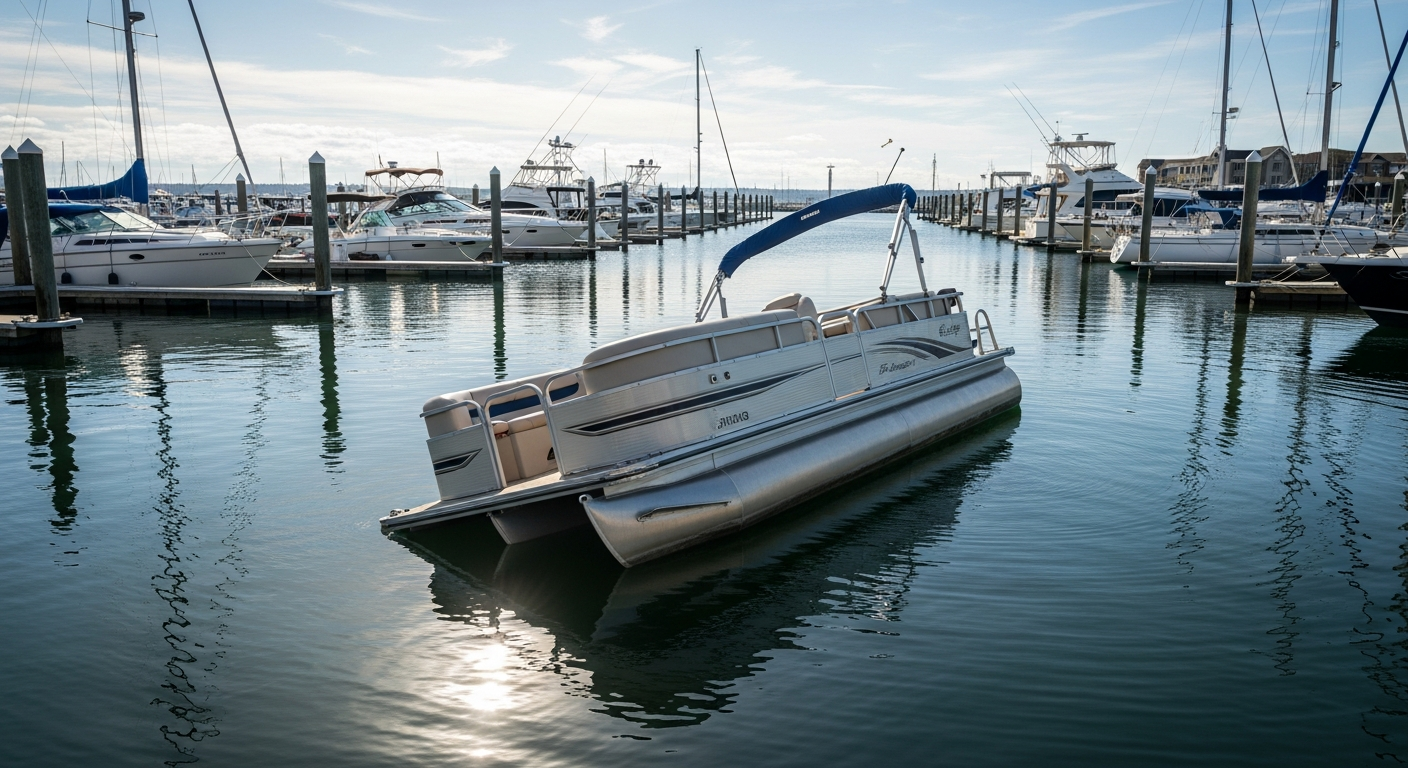
🔧 Why Your Pontoon Sits Low in the Back (and How to Fix It)
A pontoon that sits noticeably lower at the stern than the bow — whether on the trailer, on a lift, or in the water — is telling you something is wrong. The tilt may be subtle (an inch or two) or dramatic (the stern swim platform is partially submerged at rest). Either way, it is not cosmetic. A stern-low pontoon handles poorly, burns more fuel, struggles to plane, and may be hiding the most expensive repair in pontoon ownership.
There are exactly 5 causes, and you can diagnose which one you have in under 15 minutes. This is one of the most frequently asked questions in pontoon forums, and this guide walks through each cause from most common to least, with the fix and cost for each.
📊 The 5 Causes (In Order of Likelihood)
Water inside the stern log sections
Most common — 60% of casesWater trapped inside one or both pontoon logs near the stern adds hundreds of pounds exactly where the boat is already heaviest (engine, fuel tank, batteries). A single log with 10 gallons of water adds 83 lbs. Twenty gallons adds 167 lbs — enough to tilt any pontoon visibly.
How to confirm:
- Rock the boat side to side on the trailer. Listen for sloshing — the swooshing sound test.
- Open the stern drain plugs with the bow elevated. Measure how much water drains out.
- If water drains: you have a leak — drain plug failure, tearaway pad crack, or weld seam breach.
Weight distribution — too much at the stern
Common — 20% of casesPontoons are inherently stern-heavy because the engine, fuel tank, and batteries all live at the back. Adding aftermarket gear to the stern — a second battery, a trolling motor, a cooler full of drinks, an anchor locker loaded with chain — compounds the problem.
How to confirm:
- Remove all gear and passengers. Does the boat still sit low, or does it level out?
- If it levels out when empty: the problem is load distribution, not structural.
Oversized or overfilled fuel tank
Moderate — 10% of casesGasoline weighs 6.3 lbs per gallon. A full 50-gallon tank adds 315 lbs at the stern. Some owners have upgraded to larger aftermarket tanks without considering the weight impact — a 70-gallon tank adds 441 lbs when full.
How to confirm:
- Check the boat with a full tank versus a quarter tank. If the stern rises noticeably with less fuel, the tank weight is the issue.
- Check whether the tank is factory or aftermarket. An aftermarket tank that is larger than the original design spec will always cause a stern-heavy condition.
Engine too heavy for the transom design
Less common — 7% of casesAn engine swap to a larger, heavier outboard shifts weight to the stern. A 200 HP four-stroke weighs approximately 500 lbs. Upgrading from a 90 HP (350 lbs) to a 200 HP adds 150 lbs to the very back of the boat, a problem discussed in this Reddit thread about motor mount height. Some pontoon transoms are not designed for this weight differential.
How to confirm:
- Did the boat sit level before the engine swap? If yes, the new engine is the cause.
- Check the hull capacity plate — does the new engine exceed the maximum rated HP/weight?
Structural damage — bent cross-members or log deformation
Rare — 3% of casesImpact damage from hitting a submerged object, grounding on a sandbar at speed, or a trailering accident can bend the aluminum cross-members that connect the logs to the deck. If a stern cross-member is bent downward, that corner of the boat drops.
How to confirm:
- Crawl under the boat and sight along each cross-member. They should be straight and parallel to each other.
- Check the logs for dents, creases, or bowing near the stern.
- Look for grinding marks, mismatched paint, or repair welds — signs of previous impact repair.
⚡ Quick Diagnosis Flowchart
⚠️ Why It Matters Beyond Appearance
A stern-low pontoon is not just an aesthetic issue. It creates real performance and safety problems:
- Difficulty planing. The stern-low attitude increases drag on the logs, requiring more power to get on step. The bow rises higher during acceleration, blocking visibility.
- Poor fuel economy. A boat pushing through water at an angle burns 15–25% more fuel than one running level. The stern logs are partially submerged, creating additional drag.
- Water over the stern. In waves or wakes, a low stern invites water onto the swim platform and into the cockpit. This is a swamping risk in rough conditions.
- Accelerated wear. The stern hardware — drain plugs, motor mount, transom welds — takes more stress from wave impact when the stern rides low. Problems compound.
- Resale impact. An experienced buyer who sees a stern-low pontoon immediately suspects water in the logs — the most expensive repair. Even if the actual cause is benign (weight distribution), it reduces buyer confidence and offer prices.
🛡️ Prevention
- Check drain plugs every spring — replace gaskets annually. A $2 gasket prevents the #1 cause of water intrusion.
- Weigh your stern gear. Add up everything behind the helm: engine, fuel (at full), batteries, trolling motor, anchor, cooler, livewell water. If it exceeds 40% of the boat's total loaded weight, redistribute.
- Inspect tearaway pads annually — a 5-minute crawl-under check catches cracks before they become leaks. The PontoonForums maintenance section has extensive photo threads showing what to look for.
- Trim the engine correctly. Many stern-low pontoons improve dramatically with proper engine trim — tilting the engine out 2–3 degrees lifts the stern at cruising speed.
- Check your weight-to-HP ratio. Run your numbers through the Universal Propping Chart — if the engine is marginal for your loaded weight, stern-heavy trim is the first symptom. Boats sold as "boat show specials" with minimum-rated engines are the most common victims.
- Include a level check in your seasonal maintenance routine. A pontoon that was level last year and is low this year has developed a new problem — catch it early.
Related Guides
A stern-low pontoon often connects to multiple other problems. If your boat also handles poorly in wind, see our wind-sailing and docking guide — a stern-low attitude makes crosswind docking significantly harder. For gear that helps compensate — including hydrofoils and trim tab options — see the pontoon gadgets directory.