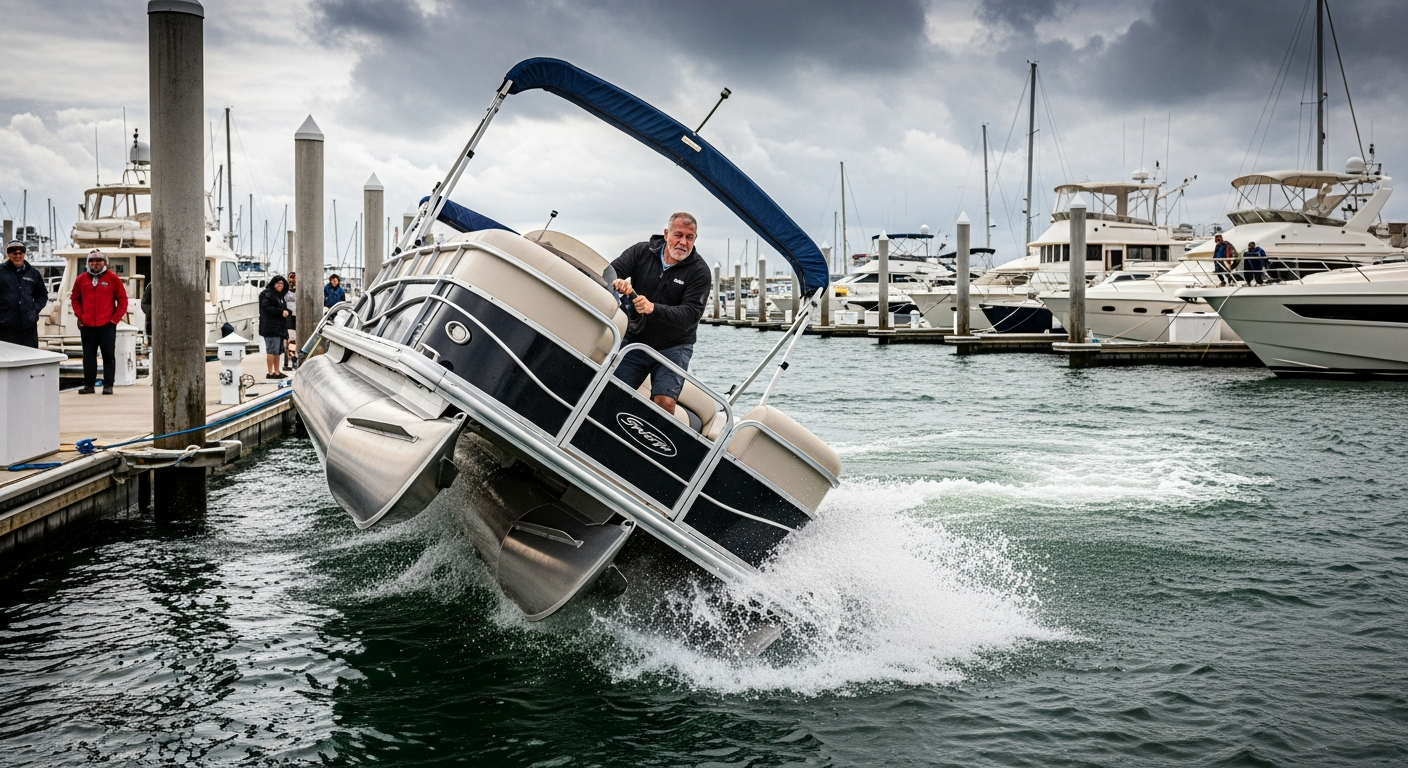
🌊 How to Dock a Pontoon in Wind Without Looking Like a Rookie
Pontoon boats are floating billboards. Two flat aluminum tubes topped by a wide deck, high fencing, and a bimini top catch wind like a sail — and the boat drifts sideways faster than most engines can correct. Forum members call this "wind-sailing" and it is the single most stressful moment of pontoon ownership for new captains.
The marina walk of shame — climbing off a pontoon that has just bounced off three boats, a dock piling, and a kayak — is entirely preventable. These techniques come from experienced captains on PontoonForums and Reddit who dock in 15–20 mph crosswinds without incident. The key is approach angle, throttle control, and using the wind instead of fighting it.
🔍 Why Pontoons Wind-Sail So Badly
Every boat is affected by wind. But pontoons are disproportionately affected because of their sail area-to-underwater resistance ratio. A pontoon presents a large flat surface above the waterline (deck, fencing, bimini, passengers) and a relatively small surface below (two or three smooth cylindrical tubes). There is very little underwater profile to resist lateral wind force.
Compare this to a V-hull runabout, which has a deep keel that resists sideways drift. Or a sailboat, which has a centerboard or keel specifically designed to counteract wind force. A pontoon has neither — just smooth tubes that slide sideways through the water with almost zero resistance.
What makes it worse
- Bimini top deployed: Adds 40–60 square feet of wind catch above the center of gravity. Lowering the bimini in high wind is the single most effective thing you can do before attempting a dock approach.
- Passengers standing: Six standing adults add roughly 30 square feet of additional sail area. Ask everyone to sit down before docking.
- Underpowered engine: An engine that can barely push the boat forward at cruise speed has no chance of correcting lateral drift in wind. This is another reason the "boat show special" causes problems beyond just speed.
- Bow-heavy loading: Weight forward lifts the stern, reducing prop and rudder effectiveness. Move weight aft before docking. Owners in this launching and loading discussion confirm that weight distribution makes a noticeable difference in wind handling.
⚡ The 4 Crosswind Docking Techniques
These are listed in order of usefulness. Technique 1 solves 80% of wind-docking situations.
Technique 1: Wind-side approach (let the wind push you in)
This is the technique every experienced captain uses first. Instead of fighting the wind, approach the dock from the upwind side so the wind pushes you toward the dock rather than away from it.
- Determine wind direction. Which way is the wind blowing relative to the dock?
- Position the boat upwind of your target slip or dock space.
- Approach at a 30–45 degree angle to the dock, bow pointed slightly into the wind.
- Cut throttle to idle when you are one boat-length away. Let the wind carry you sideways toward the dock.
- Use short bursts of forward thrust and steering to control your angle as the wind pushes you in.
- When the bow reaches the dock, have a passenger step off with a bow line. Then walk the boat into position.
The critical insight: You are not driving the boat to the dock. You are positioning the boat upwind and letting the wind do the work. Your engine is only there for fine adjustments.
Technique 2: Spring line pivot
When you cannot approach from upwind (the dock is on your lee side, or other boats block the upwind approach), use a spring line to pivot the boat into position.
- Approach the dock at a steep angle — nearly perpendicular — from whatever direction is available.
- Get the bow close enough for a passenger to step off with a line. This is the hardest part.
- The passenger ties the bow line to a cleat at the midpoint of the boat's intended parking spot — not at the bow position.
- With the bow secured, put the engine in slow forward with the wheel turned away from the dock.
- The prop pushes the stern toward the dock while the bow line acts as a pivot point. The boat swings parallel to the dock.
- Once parallel, kill the engine and secure stern line.
This technique works because the spring line converts forward thrust into rotational force. The wind is irrelevant once the bow is secured — the engine does all the work.
Technique 3: Stern-first approach
In strong crosswinds where the bow keeps blowing off course, back in stern-first. Most pontoon engines have better directional control in reverse than forward because the prop thrust pushes directly against the water rather than deflecting off a rudder.
- Position the boat parallel to the dock, one boat-length out.
- Put the engine in reverse and steer the stern toward the dock.
- Use short bursts — not sustained reverse. Sustained reverse on a pontoon tends to pull the bow sideways.
- When the stern is close, have a passenger secure a stern line first, then walk the bow in.
This technique feels counterintuitive but experienced captains use it regularly in 15+ mph crosswinds.
Technique 4: Wait it out (seriously)
If the wind is gusting above 20 mph and you do not have a confident crew, anchor out and wait for the wind to drop. On most lakes, afternoon thermal winds die down after 5–6 PM. Thirty minutes of anchoring is cheaper than a dock collision that damages gel coat, fencing, or another boat.
This is not a failure — it is what experienced captains actually do. The forums are full of stories — like this r/boating thread on wind docking tactics — from owners who tried to force a docking in 25 mph gusts and regretted it. Nobody has ever posted "I wish I hadn't waited for the wind to drop."
🛡️ Gear That Helps
| Item | Why It Helps | Cost |
|---|---|---|
| Dock bumpers (4 minimum) | Absorb contact when wind pushes you in harder than planned. Place two on each side at the widest point of the hull. | $30–$60 Buy → |
| Spring lines (2) | Enable the spring line pivot technique. 15–20 ft of 3/8" nylon dock line with a spliced loop. | $15–$25 each Buy → |
| Boat hook (8–12 ft telescoping) | Lets a passenger grab a dock cleat or piling from 8 feet away — critical when the wind pushes the bow off before anyone can step off. | $25–$45 Buy → |
| Cleats on both bow and stern | Many entry-level pontoons only have bow cleats. Adding stern cleats enables spring line techniques and proper 4-point tie-up. | $20–$40 Buy → |
For more gear that experienced owners keep aboard, see the full handy hints and gadgets directory.
🔧 Pre-Docking Checklist
Run through this before every docking approach in wind. Takes 30 seconds and prevents 90% of docking problems.
- Lower the bimini — reduces sail area by 40–60 square feet
- Ask all passengers to sit down — lowers the center of gravity and reduces windage
- Assign one passenger to bow line duty — brief them: step off with the line, wrap the cleat, do not jump
- Place bumpers on the dock side before approach — two at the widest point of the hull
- Determine wind direction — which way will the wind push the boat during approach?
- Choose your technique — upwind approach if possible, spring line if not, stern-first as backup
- Communicate the plan — tell your crew what you are going to do before you do it. "I'm going to come in from the left. When we get close, step off with the bow line and wrap that cleat."
⚠️ The Three Most Common Mistakes
Mistake 1: Coming in too fast
Speed does not help. Coming in fast gives you momentum, but you cannot stop a 3,000-lb pontoon quickly — and the moment you cut throttle, the wind takes over anyway. Approach at idle speed. Always. The only throttle bursts should be short corrections, not sustained power.
Mistake 2: Fighting the wind head-on
Trying to hold the boat perfectly parallel to the dock while the wind pushes you sideways is a losing battle. The wind will always win on a pontoon. Use the wind as part of your approach — come in at an angle that lets the wind push you toward the dock, not away from it.
Mistake 3: No plan, no communication
The captain assumes the passenger knows what to do. The passenger assumes the captain will get the boat close enough to reach the dock. Neither speaks until the boat is sideways, drifting into the neighbor's swim platform, and everyone is yelling.
Brief your crew before every approach. Thirty seconds of "here's the plan" prevents ten minutes of chaos. This is what experienced captains do — not because they need help, but because it makes the whole process calm and predictable.
When the Wind Is Too Much for Your Engine
If your engine consistently cannot overcome crosswind drift — if you find yourself unable to hold the boat on course at idle speed in moderate wind — the engine may be undersized for the boat. This is especially common on pontoons sold as "boat show specials" with minimum-rated engines.
Check your setup against the Universal Propping Chart. If your weight-to-HP ratio is above 35 lbs/HP, wind-sailing problems will persist regardless of docking technique — the engine simply cannot produce enough lateral force to counteract the wind on a high-windage hull.
For a complete rundown of seasonal checks including docking gear inspection, see the seasonal maintenance checklist.