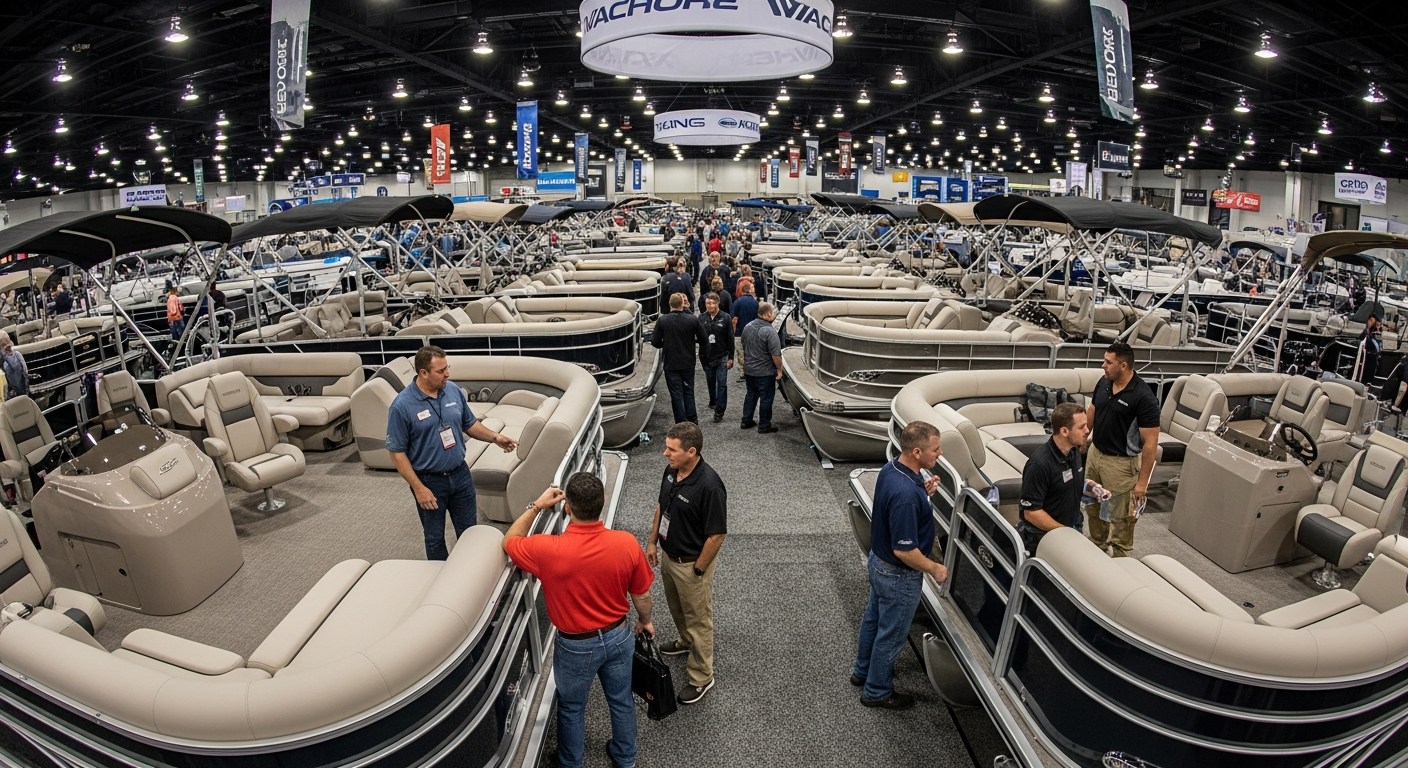
⚠️ Why the "Boat Show Special" Is Designed to Underpower Your Pontoon
Walk into any major boat show and you will find pontoon packages priced thousands below what the same boat costs at a dealership. The banner says "Show Special — This Weekend Only." The price looks too good to pass up. And in most cases, it is too good — because the engine is too small.
Forum members coined the term "boat show special" to describe a specific dealer tactic: pairing a full-size pontoon hull with the minimum-rated engine to hit an aggressive show price. A pontoon design engineer on Reddit confirmed that dealer packaging decisions often prioritize price over performance. The boat technically runs. It passes sea trial with two people aboard on flat water. But the moment you load up the family, the cooler, and the dog on a windy Saturday — it can't plane, it bogs in turns, and you spend the afternoon wishing you had listened to the guy in the forum who told you not to buy it.
🔍 How the Boat Show Special Works
Every pontoon hull has a maximum horsepower rating stamped on the capacity plate. A 24-foot pontoon might be rated for 90–200 HP. The rating tells you the range the hull can safely handle — it does not tell you the range that will make the boat enjoyable to operate.
Dealers know that a lower HP engine costs less — sometimes $3,000–$8,000 less than the next bracket up. At a boat show, where price is the primary competitive weapon, the incentive is to pair the hull with the lowest rated engine and pass the savings to the sticker price.
Here is what that looks like in practice:
| Boat | Show Package | Owner-Recommended | Price Difference |
|---|---|---|---|
| 22 ft pontoon (2,800 lbs dry) | 90 HP | 150 HP | ~$4,000–$6,000 |
| 24 ft pontoon (3,200 lbs dry) | 115 HP | 175–200 HP | ~$5,000–$8,000 |
| 25 ft tritoon (3,800 lbs dry) | 150 HP | 225–250 HP | ~$6,000–$10,000 |
The dealer is not lying about the rating. The 90 HP engine is rated for that 22-foot hull. What they are not telling you is that the rating assumes calm water, minimal load, and a driver who does not mind cruising at displacement speed while every other boat on the lake passes them.
📊 The Math That Dealers Hope You Never Learn
The pontoon community uses a simple weight-to-HP ratio to determine whether a setup is adequately powered. The formula:
Total Loaded Weight ÷ HP = Weight-per-HP Ratio
- Below 25 lbs/HP: Performance range — skiing, tubing, fast cruising
- 25–30 lbs/HP: Adequate — comfortable cruising, planes with full load
- 30–35 lbs/HP: Marginal — struggles with full load, bogs in wind
- Above 35 lbs/HP: Underpowered — the "boat show special" zone
Here is what a typical "boat show special" looks like by the numbers:
A 24-foot pontoon with a dry weight of 3,200 lbs. Add 6 passengers at 180 lbs each (1,080 lbs), plus 150 lbs of gear. Total loaded weight: 4,430 lbs.
With the show-special 115 HP engine: 4,430 ÷ 115 = 38.5 lbs per HP. That is deep into the underpowered zone. The boat will struggle to plane, burn more fuel lugging at low RPM, and feel sluggish every time you try to dock in crosswind.
With the owner-recommended 200 HP engine: 4,430 ÷ 200 = 22.2 lbs per HP. Performance range. The boat planes quickly with a full load, handles wind, and still has reserve power for tubing.
Run your own numbers with the Universal Propping Chart — it takes 30 seconds and uses the same math experienced owners rely on.
⚡ Five Signs You Bought a Boat Show Special
Already own a pontoon and suspect you are underpowered? These are the symptoms forum members report most frequently:
- Can't plane with a full passenger load. The bow stays up, the stern digs in, and the engine screams at high RPM without the boat getting on step. This is exactly the scenario one buyer described after purchasing a pontoon with 60 HP and wondering if they would have regrets.
- Bogs down in turns. The boat slows dramatically when turning, and the engine drops below its power band. You have to straighten out and re-accelerate to regain speed.
- "Wind-sailing" at the dock. The boat drifts sideways in crosswinds faster than the engine can correct, making docking a two-person operation. Full wind-sailing guide here.
- WOT RPM above the engine's range. If your tachometer shows RPM above the manufacturer's rated WOT range at full throttle, your prop pitch is too low — often a sign the dealer compensated for an undersized engine by dropping pitch.
- Fuel economy is worse than expected. Counterintuitively, underpowered pontoons burn more fuel — not less. The engine runs at higher RPM percentages for longer periods, working harder to move the same weight.
🔧 What to Do If You Are Already Underpowered
Option 1: Repower (expensive but definitive)
Swapping to a larger engine costs $8,000–$15,000+ depending on the HP jump and whether the rigging needs to change. It is the most effective fix but only makes financial sense if the hull and furniture are in good condition and you plan to keep the boat 5+ years.
Option 2: Optimize your prop (moderate improvement)
Dropping 1–2 inches of prop pitch gives you faster hole shot and better acceleration at the cost of top speed. This does not add power — it changes how the existing power is delivered. It helps with planing on full loads but does not fix a fundamentally undersized engine.
Check your current setup against the recommended specs with the Propping Chart. If your WOT RPM is outside the target range, a prop change may help.
Option 3: Manage your load (free but limited)
Distribute weight evenly across the boat. Move heavy coolers and gear toward the center rather than the stern. Trim the engine correctly — most underpowered pontoons run with too much negative trim, which forces the bow up and increases drag. These adjustments help but do not solve the underlying power deficit.
🎯 How to Protect Yourself at a Boat Show
Boat shows are excellent places to compare layouts and features. They are terrible places to make final HP decisions. Before signing anything:
- Know your loaded weight. Dry weight + (typical passengers × 180 lbs) + 150 lbs gear. This is the number that matters — not what is on the capacity plate.
- Run the Propping Chart on your phone at the show. Takes 30 seconds. If the show-package HP puts you above 30 lbs/HP, you are looking at an underpowered setup.
- Ask the dealer what happens if you upgrade the engine. Most show packages allow engine upgrades at additional cost. Get the price difference in writing at the show — it is often lower than the same upgrade at a dealership after the event.
- Never test-ride with two people and assume it represents a full-load experience. The sea trial with you and the salesperson on flat water tells you nothing about how the boat handles with 8 people in afternoon chop.
- Compare the show price to the same boat with the right engine. The $4,000–$8,000 more for adequate HP is the cheapest upgrade you will ever make on a $25,000+ boat. Boating Magazine's pontoon buyer's guide walks through how to properly spec a pontoon by use case. The alternative is years of regret or a $10,000+ repower later.
Specific HP Guides by Engine Size
For detailed breakdowns of what each HP bracket can and cannot do on pontoons of various sizes:
- 90 HP Pontoon Propping Guide — what this engine actually handles (and where it falls short)
- 150 HP Pontoon Propping Guide — the sweet spot for most 22–24 foot pontoons