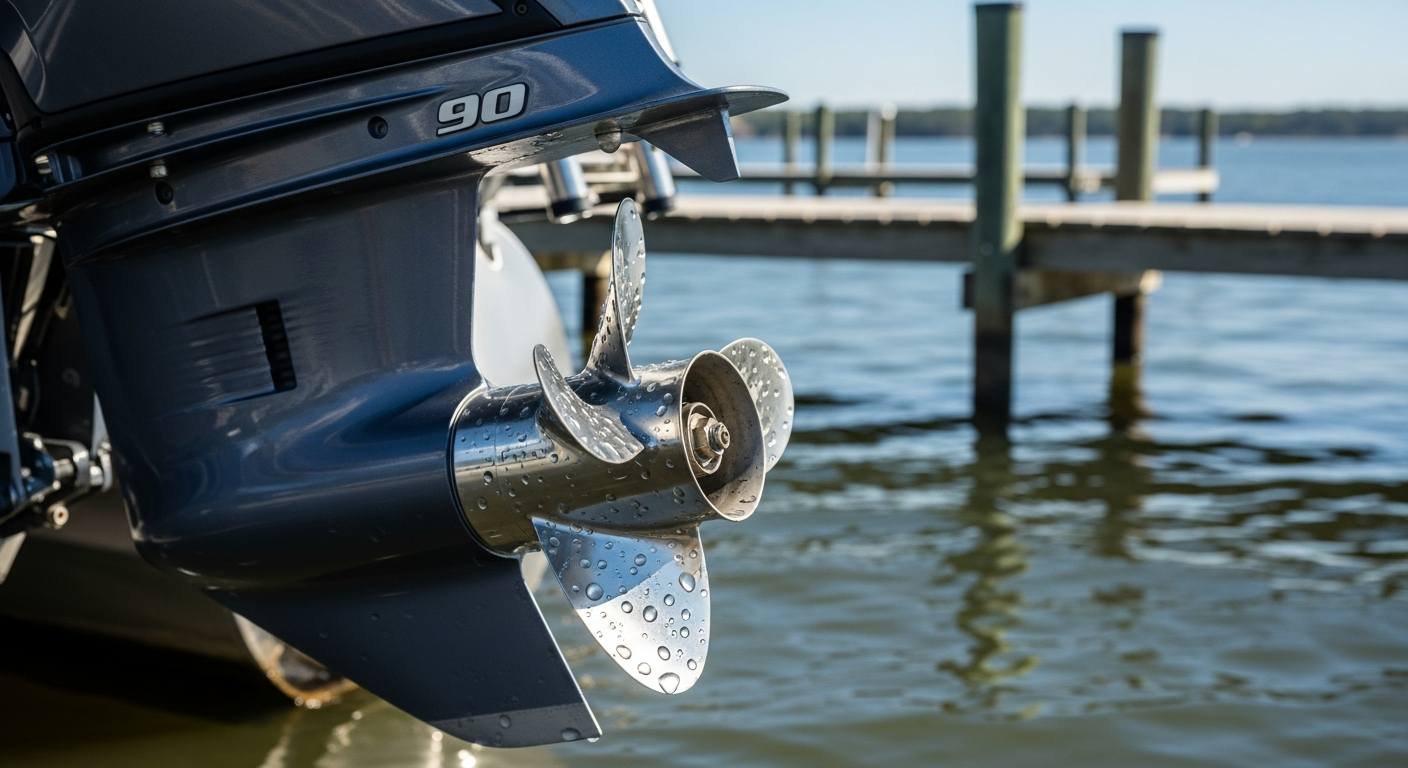
⚡ Pontoon Propping Guide: 90 HP
The 90 HP outboard is where most budget-conscious pontoon buyers land — and where most propping mistakes begin. It is the engine dealers pair with 18- to 22-foot pontoons at boat shows because the price looks right on the banner. For the right boat and the right expectations, 90 HP is perfectly adequate. For the wrong boat, it is years of frustration disguised as a good deal.
This guide covers the real-world prop specs, RPM targets, and limitations of 90 HP on pontoons — sourced from owner reports across Reddit, PontoonForums.com, and Club Bennington, not manufacturer marketing sheets.
🎯 Who Runs 90 HP on a Pontoon
The 90 HP bracket is the entry point for pontoon ownership. It shows up most often on these setups:
- 18- to 22-foot dual-tube pontoons — the most common pairing by far
- Fishing-focused builds — anglers who prioritize deck space and trolling motor compatibility over speed
- Budget-conscious first-time buyers — families stepping up from a deck boat or aluminum fishing rig
- Small lake and river boats — where top speed is less important than maneuverability
If you are running a light 18- or 20-foot pontoon with 2 to 4 passengers on calm water, 90 HP does the job without complaint. The problems start when the boat gets longer, heavier, or more crowded than the dealer assumed during the sea trial.
📊 The 90 HP Reality Check
Here is what 90 HP can and cannot do on a pontoon, based on what owners consistently report:
What 90 HP Handles Well
- Planes a 20-foot pontoon with 4 to 5 adults on flat water
- Cruises at 18 to 22 mph with moderate load — adequate for a relaxing afternoon
- Handles mild chop on smaller lakes without excessive struggle
- Burns less fuel than larger engines — 5 to 7 gallons per hour at cruise
- Weighs approximately 350 lbs, keeping total transom load manageable on lighter boats
Where 90 HP Falls Short
- Cannot reliably plane a 22-foot pontoon loaded with 6+ adults
- Struggles in afternoon crosswind on open lakes — the boat wind-sails faster than the engine can correct
- Bow rise during planing lasts 6 to 10 seconds with heavy loads, creating blind spots
- Top speed drops to 14 to 16 mph when loaded — below planing threshold for some setups
- No reserve power for towing tubes or pulling water toys
The breakpoint for most owners is passenger count. With 2 to 4 adults on a 20-foot boat, 90 HP feels fine. Add a fifth and sixth passenger plus a cooler full of ice, and the boat sits lower in the water, the bow rise gets longer, and the engine runs near redline trying to push the load onto plane.
⚡ Prop Specs for 90 HP Pontoons
These recommendations are based on owner-reported WOT RPM data and prop shop advice aggregated from pontoon forums. All specs assume a standard 3-blade prop.
| Boat Size | Loaded Weight | Diameter | Pitch | Material | Target WOT RPM |
|---|---|---|---|---|---|
| 18–20 ft | 2,000–2,800 lbs | 13" | 17" | Aluminum | 5,200–5,800 |
| 20–22 ft | 2,800–3,500 lbs | 13.25" | 15" | Aluminum | 5,000–5,600 |
| 22 ft+ | 3,500+ lbs | Boat is likely underpowered — consider upgrading to 115 HP | |||
How to read this table: Start with your boat length and your best estimate of loaded weight (dry weight + passengers at 180 lbs each + gear). Find your row and use those numbers as a starting point. Then do a WOT RPM test on flat water with a typical load. If your RPM falls outside the target range, adjust pitch up or down by 1 inch and retest.
Notice the 22-foot row. There is no recommended prop spec because at that boat size and weight, 90 HP is not a propping problem — it is a horsepower problem. No prop change fixes an engine that cannot push the load. If you are in this bracket, read the 115 HP guide before spending money on a new prop.
🔧 Aluminum vs. Stainless at 90 HP
Short answer: aluminum is the right choice for almost every 90 HP pontoon setup.
Stainless steel props cost 2 to 3 times more than aluminum ($300–$500 vs. $150–$250) and deliver measurable benefits only when the engine is pushing enough power to exploit the stiffer blade. At 90 HP, the performance difference between aluminum and stainless is minimal — typically 1 to 2 mph of top speed and marginally faster planing.
Where stainless makes sense: if you run in rocky or shallow water where you hit things regularly, stainless is more durable. But on a 90 HP pontoon, hitting a submerged object with a stainless prop transfers more impact force to the lower unit — and a lower unit repair costs $1,500 to $3,000. An aluminum prop is designed to sacrifice itself to protect the gearcase. At this power level, that trade-off works in your favor.
Save the stainless upgrade money. If you feel like 90 HP is not enough, the right answer is more horsepower, not a more expensive prop on the same engine.
🔍 Common 90 HP Engines on Pontoons
Three engines dominate the 90 HP pontoon market. All are four-stroke, all weigh within 15 lbs of each other, and all use the same prop hub pattern. The choice between them is mostly about dealer network and warranty terms.
- Mercury 90 FourStroke — the most commonly dealer-installed 90 on new pontoons. Weighs approximately 348 lbs. Rated WOT range: 5,000–6,000 RPM. Known for smooth idle and good low-end torque.
- Yamaha F90 — weighs approximately 351 lbs. Rated WOT range: 5,000–6,000 RPM. Owners report slightly better fuel economy than the Mercury in side-by-side comparisons. Strong aftermarket support.
- Suzuki DF90A — weighs approximately 353 lbs. Rated WOT range: 5,300–6,300 RPM. Lean burn fuel injection system gives it an edge on fuel economy at cruise speeds. Less common at dealerships but well-liked by owners who have them.
All three engines use a 13-spline prop hub. Props are not interchangeable between Mercury and Yamaha/Suzuki without a hub kit change. When shopping for props, buy for your specific engine brand or confirm the hub compatibility.
⚠️ Signs Your 90 HP Is Underpowered
These symptoms show up in forum posts every week — including this owner running ~99 HP on a pontoon and others worried about underpowering — from owners who bought a 90 HP setup that should have been a 115:
- Cannot plane with 5 or more adults. The boat never gets on step — it just pushes a big wake and bogs at high RPM. If you regularly carry more than 4 people, 90 HP on anything over 20 feet is marginal.
- WOT RPM below 4,800. If your tachometer cannot reach the bottom of the engine's rated WOT range at full throttle on flat water, the prop pitch is too high or — more likely — the engine is overmatched for the load.
- Bow rise lasts more than 8 seconds. A properly propped and powered pontoon should plane within 4 to 6 seconds. If the bow stays up for 8 seconds or longer, blocking your forward visibility, the engine is fighting too much weight.
- Top speed drops more than 6 mph from light load to full load. Some speed drop is normal. But if you cruise at 22 mph solo and 14 mph loaded, the engine does not have enough reserve power for the weight swing.
- Engine runs hot on long cruise. If your engine temperature gauge creeps up during extended runs at three-quarter throttle, the engine is working harder than designed. This is the engine telling you it needs help — either less weight or more HP.
If three or more of these apply to you, a prop change will not solve it. Check the Universal Propping Chart to see where your weight-to-HP ratio falls. If you are above 30 lbs per HP, the answer is not a new prop — it is more engine.
🚨 The 90 HP Boat Show Special Problem
The 90 HP engine is the most common "boat show special" motor in pontoon sales. Dealers pair it with 22-foot (and sometimes 24-foot) boats because the package price looks competitive on the show floor. The math works on paper — the capacity plate says the hull is rated for 90 HP. But the capacity plate rates the hull, not the experience.
A 22-foot pontoon with a dry weight of 2,600 lbs, loaded with 5 passengers and gear, hits approximately 3,650 lbs. At 90 HP, that is 40.5 lbs per HP — well into the underpowered zone. The same boat with 115 HP drops to 31.7 lbs per HP, which is the minimum most owners find acceptable.
If you are shopping at a boat show and the 90 HP package looks tempting on a boat longer than 20 feet, ask the dealer to quote the same boat with 115 HP. The $3,000 to $5,000 difference now saves you from a $10,000+ repower in three years — or worse, selling a boat you hate at a loss.
📊 Prop Tuning Tips for 90 HP
If your WOT RPM test shows you are outside the target range, here are the standard adjustments:
- RPM too high (above target range): Increase pitch by 1 inch. Every inch of pitch added drops RPM by approximately 150 to 200. This gives you more top speed and better fuel economy at cruise.
- RPM too low (below target range): Decrease pitch by 1 inch. This improves hole shot and acceleration but costs top speed. If RPM is still low after dropping 2 inches of pitch, the problem is power, not prop.
- Slow to plane but RPM is in range: Consider a high-rake or cupped prop design. These grab more water during acceleration without changing the cruise RPM. Turning Point and Michigan Wheel both make pontoon-specific designs in the 90 HP range.
Never change more than one variable at a time. Change pitch, test, record your RPM. Then decide if you need further adjustment. Changing pitch and diameter simultaneously makes it impossible to know which change helped.
Next Steps
Run the numbers for your specific boat. Use the Universal Propping Chart to check your weight-to-HP ratio and get a personalized prop recommendation.
Considering the next step up? The 115 HP guide covers the most popular pontoon engine bracket — and shows exactly where 115 HP outperforms 90 HP for just a few thousand more.
Not sure if your dealer pairing is right? Read the Boat Show Special guide to learn the exact math dealers hope you never run.