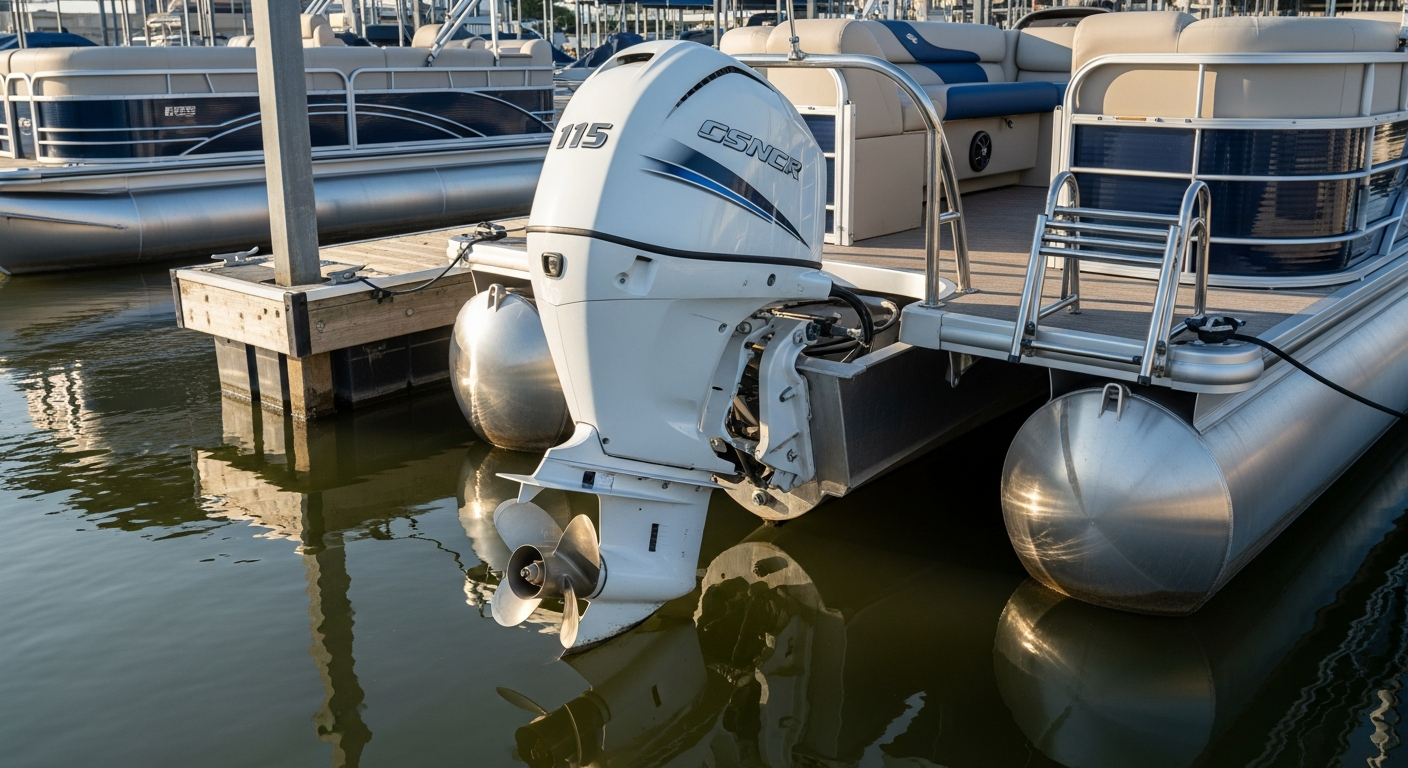
⚡ Pontoon Propping Guide: 115 HP
The 115 HP outboard is the most popular engine bracket in pontoon boating — and for good reason. It sits at the intersection of adequate power, reasonable fuel costs, and a price point that does not push the total package into sticker shock territory. As one pontoon design engineer noted on Reddit, 115 HP is the sweet spot for the majority of pontoon setups. For 20- to 24-foot pontoons used for cruising, fishing, and light towing, 115 HP is the sweet spot that most experienced owners land on.
This guide covers the real-world prop specs, RPM targets, and capability limits of 115 HP on pontoons. All data comes from aggregated owner reports across Reddit, PontoonForums.com, and Club Bennington — not manufacturer spec sheets or dealer brochures.
🎯 Who Runs 115 HP on a Pontoon
The 115 HP engine is the workhorse of the pontoon world. It shows up on more new pontoons than any other HP bracket, and owners report satisfaction rates that match:
- 20- to 24-foot dual-tube pontoons — the bread-and-butter recreational setup
- Family cruisers who carry 6 to 8 passengers regularly — weekend lake boats with real passenger loads
- Light towing setups — adequate for pulling single-rider tubes at moderate speed (not skiing, not wakeboarding)
- Fishing pontoons with accessories — trolling motor, second battery, livewell, and electronics add weight that 90 HP cannot always handle
- Owners who upgraded from 90 HP — the most common repower jump in pontoon boating
If 90 HP is where budget buyers start, 115 HP is where most owners wish they had started. The $3,000 to $5,000 premium over 90 HP buys a measurable improvement in planing speed, loaded performance, and wind handling that makes the boat feel like a different machine.
📊 115 HP Capability Breakdown
Here is what 115 HP actually delivers on pontoons, reported by owners who live with these setups every season:
What 115 HP Handles Well
- Planes a 22-foot pontoon reliably with 6 to 8 adults — the passenger count where 90 HP starts failing
- Cruises at 20 to 26 mph with moderate load, depending on boat length and weight
- Handles moderate afternoon wind and light chop without struggling to maintain course
- Pulls a single-rider tube at 18 to 22 mph — adequate for casual tubing with kids and lighter adults
- Burns 6 to 9 gallons per hour at cruise, keeping fuel costs reasonable for a full day on the water
- Weighs 380 to 400 lbs depending on brand — manageable on most dual-tube transoms
Where 115 HP Reaches Its Limits
- Cannot pull a skier or wakeboarder — not enough sustained torque at towing speeds
- Struggles with 24-foot boats loaded above 4,500 lbs total — planing becomes slow and fuel economy drops
- Not adequate for tritoons — the additional drag of a third tube eats into the power advantage
- Afternoon wind on large open lakes (1,000+ acres) can make docking difficult with a full load
- Top speed with full passenger load drops to 16 to 20 mph on longer boats — still planes, but barely
The 115 HP sweet spot is a 20- to 22-foot pontoon with a typical weekend load of 4 to 6 people. At that combination, owners report the boat feels responsive, planes in under 5 seconds, and cruises comfortably at 22 to 24 mph. Push past 22 feet or 8 passengers and you start trading comfort for compromise.
⚡ Prop Specs for 115 HP Pontoons
These recommendations are sourced from owner WOT RPM data and prop shop guidance aggregated from pontoon communities. All specs assume a standard 3-blade prop.
| Boat Size | Loaded Weight | Diameter | Pitch | Material | Target WOT RPM |
|---|---|---|---|---|---|
| 20–22 ft | 2,500–3,200 lbs | 13.25" | 19" | Aluminum | 5,400–5,800 |
| 22–24 ft | 3,200–4,000 lbs | 13.75" | 17" | Aluminum | 5,200–5,600 |
| 24 ft+ | 4,000+ lbs | 14" | 15" | Aluminum | 5,000–5,400 |
How to read this table: Calculate your loaded weight (dry weight + passengers at 180 lbs each + gear). Find your row and use those specs as your starting point. Then run a WOT RPM test on flat water with a typical load and adjust pitch 1 inch at a time until you land in the target range.
Notice the trend: as boat size and weight increase, the diameter goes up and pitch goes down. Larger diameter grabs more water to move the heavier boat. Lower pitch trades top speed for the acceleration and pulling power needed to get the heavier load on plane.
The 24-foot row deserves a note. At 4,000+ lbs loaded, 115 HP works — but it is working hard. Owners in this bracket report acceptable performance in calm conditions and noticeable strain in wind or with maximum passengers. If you regularly load a 24-foot pontoon to capacity, the 150 HP guide shows what the next bracket delivers.
🔧 When Stainless Makes Sense at 115 HP
Unlike the 90 HP bracket where aluminum is almost always the right call, 115 HP is the point where a stainless steel prop starts to earn its premium for certain owners. The question is whether your use case justifies the $200 to $300 price increase.
Upgrade to Stainless If
- You tow tubes regularly. Stainless blades flex less under sustained load, holding their designed pitch more consistently. This matters when the prop is fighting tube drag for extended periods — aluminum blades flex and lose 1 to 2 inches of effective pitch under heavy load.
- You run loaded most of the time. If your boat typically carries 6+ passengers plus gear, the stainless prop's pitch consistency translates to faster planing and better fuel economy compared to the same pitch in aluminum under the same load.
- You run in weedy or debris-heavy water. Stainless blades hold their edge better and shed weeds more cleanly than aluminum, which develops nicks and burrs that catch vegetation.
Stay with Aluminum If
- You cruise with light to moderate loads (4 or fewer adults). At this load, aluminum and stainless perform almost identically.
- You run in rocky or shallow water. An aluminum prop sacrifices itself to protect the gearcase. A stainless prop transfers impact force to the lower unit — and a lower unit repair is $1,500 to $3,000.
- Budget is a factor. The $200 to $300 saved on an aluminum prop is better spent toward a higher HP engine on your next boat than a marginal improvement on your current setup.
A practical middle ground: buy the aluminum prop first, run it for a season, and record your WOT RPM and planing times with various loads. If you find yourself consistently loaded and wishing for faster planing, a stainless upgrade in the same diameter and pitch gives you an apples-to-apples improvement.
🔍 Common 115 HP Engines on Pontoons
The 115 HP bracket has the most competitive field in outboard motors. Every major manufacturer has a strong entry, and the differences between them are smaller than forum debates would suggest.
- Mercury 115 FourStroke — the most common 115 on new pontoons, largely because Mercury has the deepest dealer network. Weighs approximately 381 lbs. Rated WOT range: 5,200–6,000 RPM. Known for smooth shifting and quiet operation at cruise.
- Yamaha F115 — weighs approximately 389 lbs. Rated WOT range: 5,000–6,000 RPM. Owners consistently praise the Yamaha's durability and resale value. Strong aftermarket parts availability.
- Suzuki DF115BG — weighs approximately 399 lbs. Rated WOT range: 5,300–6,300 RPM. The lean burn fuel injection system gives it a measurable fuel economy advantage at cruise speeds — owners report 8 to 12 percent better mileage than competitors in side-by-side tests.
All three use similar prop hub systems but are not directly cross-compatible without hub kit changes. When buying aftermarket props, confirm the hub type matches your specific engine brand and year.
Dealer network matters more than engine specs at this level. The performance differences between these three engines are marginal. What matters is whether you have a competent service dealer within 30 minutes of your lake — because every outboard needs maintenance, and warranty work requires an authorized dealer.
⚠️ The 115-to-150 Question: When You Wish You Had Gone Bigger
The single most common post from 115 HP pontoon owners on forums reads some version of: "Love the boat, wish I had gotten 150." It is predictable enough that experienced members preemptively advise new buyers to stretch for 150 whenever the budget allows.
Here are the specific scenarios where 115 HP owners report wanting more power:
- Added a trolling motor and second battery after purchase. A trolling motor setup adds 80 to 120 lbs of weight that was not on the boat during the sea trial. That weight is also mounted at the bow, which changes the trim dynamics and slows planing.
- Regularly carry 8 or more passengers. The difference between 6 and 8 passengers is 360 lbs — equivalent to strapping a second engine to the boat. At 115 HP, this pushes a 22-foot pontoon from comfortable to marginal.
- Bought a 24-foot boat and added accessories. Bimini top, mooring cover, ski tow bar, marine stereo, extra batteries — the accessory weight adds up faster than most buyers expect. A fully-equipped 24-footer can weigh 500 to 800 lbs more than its base dry weight.
- Moved to a bigger or windier lake. The 115 HP that felt fine on a 200-acre protected lake feels inadequate on a 2,000-acre reservoir with afternoon whitecaps.
- Discovered tubing and wanted more speed. The 115 HP pulls a tube, but barely. A 150 HP makes tubing genuinely fun because you have enough speed reserve to maneuver with the tube deployed, not just drag it in a straight line.
The honest answer: If two or more of these scenarios describe your future plans, buy the 150. The $4,000 to $6,000 difference between 115 and 150 HP on a new boat is a fraction of what a repower costs later — and you get the better experience from day one.
If none of these apply — you run a 20- to 22-foot boat with 4 to 6 people on calm water for cruising and fishing — 115 HP is genuinely the right engine and you will not regret it.
📊 Prop Tuning Tips for 115 HP
Once you have the right diameter and pitch from the table above, fine-tuning comes down to your WOT RPM test results:
- RPM too high (above target range): Increase pitch by 1 inch. Each inch of pitch added drops RPM by approximately 150 to 200. You gain top speed and better fuel economy at cruise. Do not add more than 2 inches above the recommended pitch without retesting — over-pitching lugs the engine and causes long-term damage.
- RPM too low (below target range): Decrease pitch by 1 inch. You gain hole shot speed and better loaded acceleration. If RPM is still below range after dropping 2 inches, the prop is not the problem — the engine is overmatched for the weight.
- Planing time over 6 seconds with full load: Consider a 4-blade prop instead of 3-blade. Four-blade props sacrifice 1 to 2 mph of top speed for significantly faster planing and better grip in turns. On a 115 HP pontoon, the top speed loss is negligible and the planing improvement is noticeable.
- Ventilation in turns: If the prop loses bite and the engine revs high during hard turns, the prop may be mounted too high on the transom or the diameter is too small. Check your engine height against the manufacturer's recommendation before swapping props.
Keep a prop log. Record the date, prop specs, passenger count, fuel level, and WOT RPM for every test run. Three data points with the same prop tell you more than one test, because wind, current, and water temperature all affect RPM. Look for the average across runs, not any single reading.
Next Steps
Check your numbers. The Universal Propping Chart calculates your weight-to-HP ratio and recommends prop specs for your exact setup in 30 seconds.
Coming from a smaller engine? The 90 HP guide covers the common upgrade path — if you currently run 90 HP and wonder whether 115 HP solves your problems, that page has the comparison data.
Thinking about going bigger? The 150 HP guide covers the next bracket up and explains exactly where the extra power makes a measurable difference.
Buying new at a show? Read the Boat Show Special guide before signing anything — 115 HP is the second most common engine dealers use to underpower boats at show pricing. For broader engine sizing context, Boating Magazine's pontoon buyer's guide covers the fundamentals of matching HP to hull size.