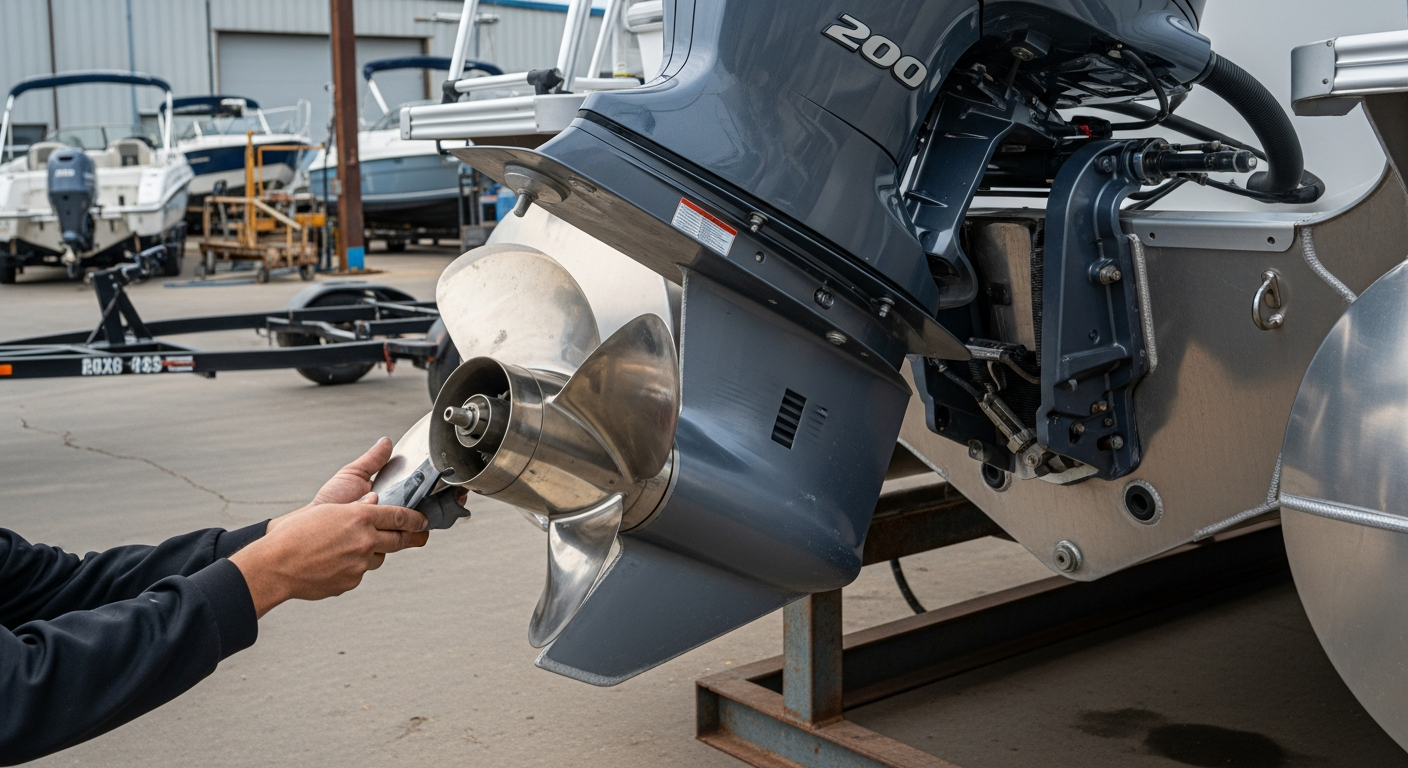
⚡ Pontoon Propping Guide: 200 HP
The 200 HP outboard is where pontoon boating enters performance territory. This is the engine bracket that transforms a tritoon from a floating living room into something that genuinely moves — 35 to 45 mph on plane, instant hole shots with a full passenger load, and enough sustained torque to pull a skier or wakeboarder without the engine begging for mercy.
Owners who run 200 HP are not buying power because a salesman talked them into it. They are buying power because they have been on the water long enough to know exactly what they need — and what they need is an engine that never makes them wait, never makes them compromise, and never leaves them wishing they had gone bigger.
This guide covers the real-world prop specs, RPM targets, stainless four-blade requirements, lab-finishing options, and performance tuning for 200 HP on pontoons and tritoons. All data comes from aggregated owner reports across Reddit, PontoonForums.com, and Club Bennington — not manufacturer marketing or dealer brochures.
🎯 Who Runs 200 HP on a Pontoon
The 200 HP bracket attracts experienced pontoon owners who have specific performance demands. This is not the engine you buy because the dealer had it in stock — it is the engine you buy because you have lived with less power and decided not to do that again:
- 24- to 28-foot premium pontoons and tritoons — the flagship models from Bennington, Barletta, Harris, and Crest where 200 HP is the standard or recommended engine rating
- Performance-oriented tritoon owners — buyers who chose a tritoon specifically for speed and handling, and want the engine that unlocks the platform's full potential
- Watersports enthusiasts — owners who pull skiers, wakeboarders, and tubes regularly and need the sustained torque to do it without overworking the engine
- Large-family boaters who carry 10 to 14 passengers — when a 26- or 28-foot pontoon is loaded to capacity, 200 HP planes the load as effortlessly as 115 HP planes a half-empty 20-footer
- Big-water boaters — owners on large reservoirs, the Great Lakes, coastal waterways, or rivers with current who need the power reserve to handle rough conditions safely
- Owners who have repowered twice and refuse to do it again — the 200 HP bracket exists partly because owners who went from 90 to 115 to 150 HP decided to stop the cycle and buy enough power the first time
The price premium is real — 200 HP costs $7,000 to $12,000 more than 115 HP on a new build, and the stainless four-blade prop that 200 HP demands adds another $400 to $600. But owners in this bracket consistently report zero regret about the investment, because they never once sit on the water wishing they had more power.
📊 200 HP Capability Breakdown
Here is what 200 HP actually delivers on pontoons and tritoons, reported by owners who run these setups in real conditions:
What 200 HP Handles With Ease
- Planes any properly matched pontoon or tritoon instantly — even with maximum passenger load, the transition from displacement to plane happens in 2 to 3 seconds with minimal bow rise
- Cruises at 30 to 38 mph on dual-tube pontoons and 35 to 45 mph on tritoons, depending on boat length, weight, and prop selection
- Handles rough water, afternoon whitecaps, and strong wind without throttle management — enough power reserve to maintain both course and speed simultaneously
- Pulls a single skier at 30 to 34 mph with power to spare — the engine does not labor at towing speeds the way 150 HP does
- Pulls a wakeboarder at 19 to 22 mph — the sustained torque at low-speed towing is where 200 HP separates from 150 HP most dramatically
- Tows tubes at 22 to 28 mph with enough surplus power to whip the tube aggressively on turns — tubing with 200 HP is a different experience than tubing with 115 or 150
- Burns 10 to 15 gallons per hour at cruise — higher raw consumption, but the improved planing efficiency and shorter time-to-plane offset some of the increase over a full day
Where 200 HP Reaches Its Limits
- Cannot safely exceed the boat's maximum HP rating — a 200 HP engine on a boat rated for 150 HP max is a structural and warranty liability, not a performance upgrade
- Weight penalty is real — 200 HP adds approximately 150 lbs over 115 HP at the stern, which can cause trim issues on lighter boats (see the sitting low in back guide)
- Fuel costs are approximately 40 to 60 percent higher than 115 HP at equivalent usage patterns — a full day of cruising and watersports costs $80 to $120 more in fuel per season outing
- Diminishing returns on dual-tube pontoons — a 24-foot dual-tube with 200 HP is fast, but the hull design limits the speed advantage over 150 HP to 3 to 5 mph because the hull itself creates drag the engine cannot overcome
- Insurance premiums increase — some insurers classify 200 HP pontoons in a higher risk bracket, adding $200 to $400 per year
The 200 HP sweet spot is a 24- to 28-foot tritoon with a typical load of 6 to 10 people. At that combination, the boat reaches its full potential — fast enough to make watersports genuinely exciting, responsive enough that docking feels easy, and powerful enough that passenger count becomes irrelevant to the driving experience. On dual-tube pontoons, 200 HP is justified primarily for watersports use — if you do not tow skiers or wakeboarders, 150 HP delivers 90 percent of the experience at 70 percent of the cost.
⚡ Prop Specs for 200 HP Pontoons
At 200 HP, stainless steel four-blade is the baseline — not an upgrade, not a recommendation, but the minimum standard. Aluminum cannot handle the torque, and three-blade props leave performance on the table that the engine is capable of delivering.
| Boat Configuration | Loaded Weight | Diameter | Pitch | Material | Target WOT RPM |
|---|---|---|---|---|---|
| 24–26 ft dual-tube | 3,800–4,800 lbs | 14.5" | 21" | Stainless | 5,600–6,000 |
| 24–28 ft tritoon | 4,500–6,000 lbs | 15" | 23" | Stainless four-blade | 5,800–6,200 |
| Performance tritoon | 5,000+ lbs | 15.25" | 25" | Stainless four-blade | 5,800–6,200 |
How to read this table: Calculate your loaded weight (dry weight + passengers at 180 lbs each + gear + fuel + accessories). Find your row and use those specs as your starting point. Then run a WOT RPM test on flat water with a typical load and adjust pitch 1 inch at a time until you land in the target range.
The performance tritoon row explained: Performance tritoons — models like the Bennington QX, Barletta Corsa, or Harris Crowne with lifting strakes and performance tubes — have significantly less drag than standard tritoons. The engineering behind center log alignment and its effect on drag is well documented in technical discussions on Boat Design Net. The reduced drag allows a higher pitch prop, which translates to higher top speed. Owners of performance tritoons consistently report 40 to 48 mph at WOT with the 15.25" diameter, 25-pitch stainless four-blade setup.
Why aluminum is not listed: At 200 HP torque levels, aluminum blades flex 2 to 3 inches under power — effectively turning a 21-pitch prop into an 18 or 19-pitch prop every time you advance the throttle. The flex also introduces blade flutter that generates vibration, accelerates cavitation, and reduces the prop's service life to 1 to 2 seasons. Every prop shop, dealer, and experienced owner in the 200 HP bracket will tell you the same thing: stainless is non-negotiable.
🔧 Stainless Four-Blade Is Non-Negotiable at 200 HP
At lower HP brackets, the aluminum vs stainless and three-blade vs four-blade conversations have nuance. At 200 HP, they do not. Here is why both decisions are settled:
Why Stainless Only
- Torque exceeds aluminum's structural limits. At 200 HP, the force on each blade during acceleration exceeds the yield threshold where aluminum deforms permanently. After a single season of regular use, an aluminum prop on a 200 HP engine shows measurable pitch deformation — blades that started at 21 inches of pitch measure 19 or 20 inches. That lost pitch is gone permanently.
- Energy transfer efficiency. Stainless blades are thinner than aluminum blades at the same strength, which means less drag per blade. At 200 HP, this translates to 3 to 5 mph more top speed and 1 to 2 seconds faster planing compared to aluminum at the same spec — differences that are impossible to achieve through any other single change.
- Vibration and noise. Aluminum blade flex at 200 HP generates harmonic vibrations that transmit through the lower unit to the transom. Owners who switch from aluminum to stainless at this power level consistently report a noticeably smoother, quieter ride.
Why Four-Blade Standard
- Hole shot matters more at higher weight. The boats running 200 HP are typically 4,500 to 6,000+ lbs loaded. Getting that weight on plane requires the additional blade area that a four-blade provides. A three-blade at the same spec takes 1 to 2 seconds longer to plane — time that feels longer than it sounds when you are accelerating away from a dock with traffic behind you.
- Bow rise elimination. On a loaded 26-foot tritoon, three-blade hole shot produces bow rise that blocks forward visibility for 3 to 4 seconds. Four-blade virtually eliminates this by distributing thrust more evenly, keeping the bow level through the transition to plane.
- Watersports demands it. Pulling a skier or wakeboarder requires consistent thrust from idle to towing speed. Four-blade props deliver smoother, more predictable acceleration through the speed range where tow sports happen (15 to 34 mph), reducing the jerky throttle response that makes skiing behind a pontoon challenging.
The top speed penalty of four-blade vs three-blade (1 to 3 mph) is irrelevant at this power level. A 200 HP tritoon running a four-blade at 42 mph does not need the 44 mph a three-blade might deliver — but it absolutely needs the hole shot, bow stability, and towing performance that only the four-blade provides.
⚙️ Lab-Finishing and Prop Tuning at 200 HP
At 200 HP, a conversation enters the picture that does not exist at lower HP brackets: lab-finishing. This is the process of having a prop shop professionally balance, true, and fine-tune your propeller on a calibrated machine — and at this power level, it delivers measurable results.
What Lab-Finishing Does
- Balances all blades to identical weight and pitch. Factory props are manufactured to tolerance ranges, not exact specs. A new prop labeled "23-pitch" might have blades measuring 22.5, 23.0, and 23.2 inches. Lab-finishing trues every blade to the exact same pitch.
- Removes casting imperfections. Even stainless props have surface irregularities from the manufacturing process. Lab-finishing smooths the blade faces, reducing drag and improving water flow across the blade.
- Cups the blade edges for better grip. Cupping — a slight curl at the trailing edge of each blade — reduces ventilation and improves thrust at higher speeds. Factory props have some cupping, but lab-finishing optimizes it for your specific boat and engine combination.
What Lab-Finishing Delivers
- 2 to 3 mph top speed improvement — consistently reported by owners who lab-finish at the 200 HP level
- Smoother operation at all speeds — balanced blades eliminate the subtle vibration that even a new factory prop produces
- Improved fuel economy at cruise — reduced drag and better water flow mean less throttle input to maintain the same speed, saving 0.5 to 1.0 GPH at cruise
- Longer prop life — balanced blades wear evenly instead of developing uneven erosion patterns that accelerate degradation
Cost: $150 to $250 at most prop shops, with a turnaround time of 3 to 7 days. Some shops offer this service on new props before you ever mount them — which is the ideal time to do it, since you start with baseline performance data from a perfectly tuned prop.
Is it worth it? At 200 HP, yes. The 2 to 3 mph improvement alone is worth more than the cost — achieving the same gain through any other modification (engine tuning, weight reduction, hull treatment) would cost significantly more. Below 150 HP, lab-finishing delivers smaller gains that are harder to justify. At 200 HP and above, it is one of the best dollar-per-mph investments available.
🔍 Common 200 HP Engines on Pontoons
The 200 HP bracket has three primary engines that dominate pontoon and tritoon installations. At this power level, all three are mature, proven platforms — the choice comes down to dealer proximity and brand loyalty more than performance differences.
- Mercury 200 FourStroke — the most common 200 on new pontoons and tritoons, backed by Mercury's extensive dealer network and OEM partnerships with major pontoon brands. Weighs approximately 490 lbs. Rated WOT range: 5,000–6,000 RPM. The V-6 block delivers exceptionally smooth power delivery, and the digital throttle response is the most refined in the bracket.
- Yamaha F200 — weighs approximately 507 lbs. Rated WOT range: 5,000–6,000 RPM. Yamaha's in-line four-cylinder design makes it slightly lighter than it sounds given the power output. Owners report the highest long-term reliability ratings and the best resale values in the 200 HP bracket.
- Suzuki DF200AP — weighs approximately 519 lbs. Rated WOT range: 5,200–6,300 RPM. Suzuki's lean burn fuel injection system delivers the best fuel economy at cruise speeds — owners consistently report 12 to 18 percent better fuel mileage than competitors in side-by-side comparisons. The AP model includes Suzuki's Precision Control digital throttle and drive-by-wire system.
The weight consideration is real at 200 HP. Engine weights in this bracket range from 490 to 520 lbs — roughly 150 lbs heavier than a 115 HP outboard. That weight sits at the extreme stern of the boat and affects trim, planing attitude, and handling. On lighter dual-tube pontoons, the additional stern weight can cause the back of the boat to sit noticeably lower at rest and push the bow up during acceleration. If you notice this after installing or repowering to 200 HP, read the sitting low in back guide for trim tab, ballast, and weight distribution solutions.
📊 Prop Tuning Tips for 200 HP
Prop tuning at 200 HP follows the same fundamentals as lower HP brackets, but the stakes and sensitivities are higher. Small changes produce larger effects because the engine is generating more torque through a narrower optimal RPM window.
- RPM too high (above target range): Increase pitch by 1 inch. At 200 HP, each inch of pitch drops RPM by 150 to 200 — the same range as lower HP, but the torque increase means the engine reaches the damaging over-rev zone faster. Do not exceed the manufacturer's maximum rated RPM by more than 100.
- RPM too low (below target range): Decrease pitch by 1 inch. At 200 HP, running below the target RPM range means the engine is lugging — generating maximum torque at too-low speed, which causes excessive fuel consumption, accelerated wear, and carbon buildup. Lugging a 200 HP engine is more damaging than lugging a 115 HP engine because the forces involved are proportionally higher.
- Planing time over 3 seconds with moderate load: At 200 HP, any properly matched pontoon or tritoon should be on plane within 3 seconds. If yours takes longer, check the prop first (four-blade, correct pitch), then check engine height, then check whether the boat is significantly heavier than you estimated.
- Speed plateau despite correct RPM: If your WOT RPM is in range but top speed is 5+ mph below what similar boats report, the likely culprits are hull drag (marine growth, damaged tubes, misaligned strakes) or prop damage. Have the prop inspected for blade damage that is not visible to the naked eye — even small dings at 200 HP torque levels affect performance measurably.
The lab-finishing advantage applies to tuning too. A lab-finished prop gives you a known-good baseline. When you record WOT RPM data with a lab-finished prop, you know the prop is performing to spec — so any RPM deviation points to the boat or engine, not the prop. This eliminates a variable that makes troubleshooting faster and more accurate.
Next Steps
Check your numbers. The Universal Propping Chart calculates your weight-to-HP ratio and recommends prop specs for your exact setup in 30 seconds.
Coming from a smaller engine? The 150 HP guide covers the most common step-up bracket — compare the capability breakdowns to see exactly where 200 HP delivers improvements that justify the premium. For video comparisons of real-world performance at this power level, Pontoon Boat Reviews on YouTube has head-to-head footage worth watching.
Running a tritoon? The tritoon vs pontoon rough water guide covers how a third tube changes handling in chop and wind — understanding those dynamics helps you choose between the standard tritoon and performance tritoon prop specs in the table above.
Stern sitting low after install? Adding 200 HP puts 490 to 520 lbs at the back of the boat. If the stern rides low at rest or the bow lifts excessively during acceleration, the sitting low in back guide covers trim solutions that restore proper attitude without compromising performance.