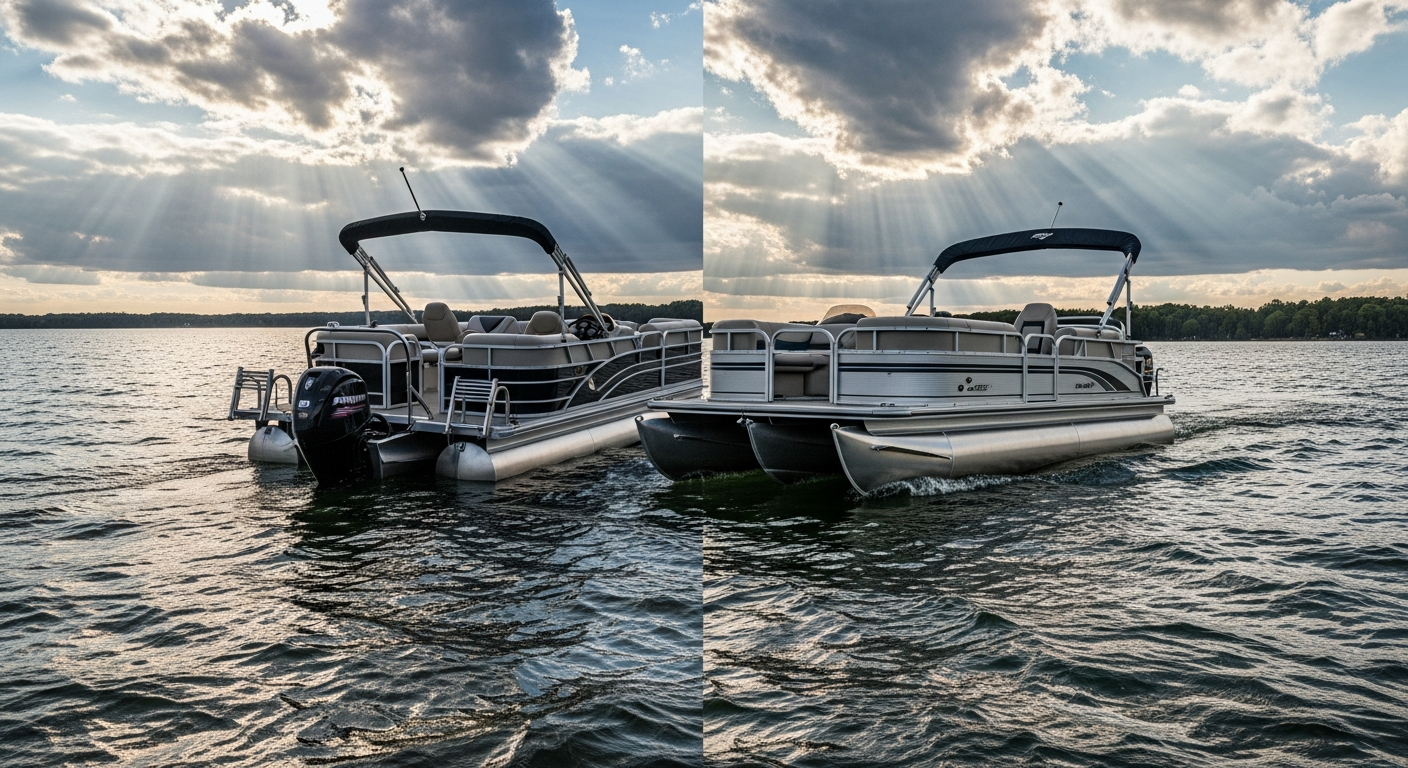
🚤 Tritoon vs Pontoon in Rough Water: When the Third Tube Actually Matters
🎯 The Verdict
Choose a tritoon if: You boat on a large lake with regular afternoon chop, you carry 6+ passengers frequently, you want watersports capability, or your boat length is 23 feet or longer. The third tube transforms rough-water handling from "bobbing like a cork" to genuinely stable.
Stay with a pontoon if: You boat on small, calm lakes, you rarely carry more than 4 passengers, your budget is firm, or your boat is under 22 feet. On calm water with light loads, the third tube adds cost without a meaningful experience difference.
📊 Side-by-Side Comparison
| Factor | Pontoon (2 tubes) | Tritoon (3 tubes) | Winner |
|---|---|---|---|
| Rough water stability | Rocks side to side; bow slaps in 1–2 ft chop | Cuts through chop; center tube dampens roll | Tritoon |
| Crosswind handling | Wind-sails badly; docking is stressful | Better lateral resistance; still affected but manageable | Tritoon |
| Top speed | 25–35 mph typical | 35–55 mph typical | Tritoon |
| Hole shot (time to plane) | 8–15 seconds loaded | 4–8 seconds loaded | Tritoon |
| Max HP rating | Usually 90–200 HP | Usually 150–400 HP | Tritoon |
| Fuel economy at cruise | 3–5 MPG | 2–4 MPG (more drag) | Pontoon |
| Purchase price | $18,000–$80,000 | $30,000–$150,000+ | Pontoon |
| Trailering weight | Lighter (2,000–4,000 lbs) | Heavier (3,000–5,500 lbs) | Pontoon |
| Shallow water draft | Better — less hull below waterline | Center tube sits deeper | Pontoon |
| Watersports | Marginal tubing; skiing difficult | Solid tubing; skiing and wakeboarding possible | Tritoon |
| Passenger capacity feel | Feels full at 8 passengers | Feels stable at 10+ passengers | Tritoon |
| Calm water cruising | Smooth, quiet, efficient | Smooth, quiet, slightly more drag | Tie |
⚡ What the Third Tube Actually Does
A tritoon adds a third aluminum log centered between the two outer tubes. This center tube provides approximately 25% more buoyancy and lift compared to a twin-tube pontoon of the same length. Engineering discussions on BoatDesign.net detail how the center log geometry affects hydrodynamic performance. But buoyancy is not the main benefit — stability is.
Roll stability
On a twin-tube pontoon, the boat pivots around the axis between the two tubes. In waves, this creates a rocking motion that passengers feel in their knees and stomachs. Forum members describe it as "bobbing like a cork" in 1–2 foot chop.
The center tube on a tritoon dampens this roll motion by creating a wider effective base. The boat still moves with the waves, but the amplitude of the roll is significantly reduced. Owners consistently describe the difference as going from "uncomfortable" to "barely noticeable" in the same water conditions.
Planing and performance
The third tube also changes how the boat gets on plane. Twin-tube pontoons plane by lifting the bow until the tubes skim the surface — which requires overcoming the drag of two large cylindrical hulls pushing water. Tritoons with lifting strakes on the center tube generate hydrodynamic lift that gets the boat on plane faster, with less bow rise, and at lower RPM.
This is why tritoons handle more horsepower. A twin-tube 24-footer maxes out around 175–200 HP because additional power just pushes the bow higher without meaningful speed gains. The same hull as a tritoon can efficiently use 250+ HP because the center tube keeps the boat level during acceleration.
Weight distribution under load
This is the advantage nobody talks about until they have experienced it. On a twin-tube pontoon with 8 passengers, the weight distribution creates noticeable list (lean) when everyone sits on one side. The boat tips toward the heavy side and the opposite tube lifts slightly. On a tritoon, the center tube absorbs this asymmetric loading, keeping the boat substantially more level regardless of where passengers are sitting.
🔍 When Forum Members Say "Stay Twin-Tube"
Not every owner who researches tritoons needs one. The experienced members on PontoonForums and Reddit recommend staying with twin tubes in these situations:
🏞️ Small, protected lake
Lakes under 500 acres with limited fetch (the distance wind travels across open water) rarely build waves above 6 inches. A twin-tube pontoon handles this with zero issues. The extra $8,000–$15,000 for a tritoon buys nothing but bragging rights on calm water.
👨👩👧 Light passenger loads
Couples and small families (4 or fewer passengers) do not stress a twin-tube pontoon's stability. The weight distribution that causes listing on a loaded twin-tube is a non-issue with light loads. Save the money for a better engine or upgraded furniture instead.
🎣 Fishing-focused use
Fishing pontoons rarely run at high speed or carry large groups. A twin-tube with the right engine provides smooth trolling speed, quiet operation, and shallower draft for getting into coves — all advantages over a heavier tritoon.
📏 Boats under 22 feet
Tritoon advantages scale with boat length. On boats under 22 feet, the third tube adds meaningful weight and drag without enough length to generate the stability benefits that make tritoons worth the premium on larger boats.
⚡ When Forum Members Say "Go Tritoon — No Question"
🌊 Large lake or reservoir
Bodies of water over 1,000 acres with regular afternoon wind build 1–3 foot chop that makes twin-tube pontoons uncomfortable. This is where tritoons earn their price premium — every outing in rough conditions reinforces the decision.
👨👩👧👦 Regular large groups
If you consistently carry 6–12 passengers (families, friend groups, lake house weekends), the stability difference is dramatic. A loaded tritoon feels like a lightly loaded twin-tube. Your passengers will thank you.
🏄 Watersports
Tubing behind a twin-tube pontoon works, but skiing and wakeboarding require the acceleration, speed, and stability that only a tritoon delivers. If watersports are a regular activity, not a once-a-summer experiment, tritoon is the baseline.
📏 Boats 23 feet and longer
At 23+ feet, the hull has enough length to fully benefit from the third tube's lift and stability. The performance gap between twin and triple tube widens with every foot of boat length above 22 feet.
📊 The Cost Reality
The price premium for a tritoon over the same model in twin-tube configuration ranges from $8,000 to $20,000 depending on brand and size. Here is how that breaks down on a typical 24-footer:
| Component | Added Cost |
|---|---|
| Third log (tube, nosecone, drain plugs) | $3,000–$5,000 |
| Additional cross-members and mounting hardware | $1,000–$2,000 |
| Engine upgrade to match higher HP rating | $3,000–$10,000 |
| Heavier-duty trailer (if included) | $1,000–$3,000 |
The engine upgrade is the hidden cost. A tritoon hull can run on the same engine as a twin-tube — but doing so defeats the purpose. The third tube enables higher HP, and the performance benefits of a tritoon only materialize when the engine matches the hull's capability. A tritoon with an undersized engine is the worst of both worlds: heavier than a pontoon with no speed or stability advantage.
Run your specific setup through the Universal Propping Chart to see the minimum HP for a tritoon at your boat length and passenger count.
🔧 What About "Performance Pontoons"?
Some manufacturers offer twin-tube pontoons with underskinning (an aluminum sheet between the two tubes) and lifting strakes welded to the outer tubes. These "performance" twin-tubes aim to deliver some tritoon benefits without the third tube.
Owner data on performance twin-tubes is mixed:
- Speed improves — underskinning creates an air pocket that reduces drag, adding 3–5 mph at top end
- Hole shot improves — lifting strakes help the boat plane faster
- Rough water stability does NOT meaningfully improve — the roll axis between two tubes remains the same regardless of underskinning. This is the critical point: speed and planing are about aerodynamics, but stability is about hull geometry, and hull geometry requires the third tube.
Performance twin-tubes are a solid option for owners who want more speed on calm water but do not need rough-water stability. They are not a substitute for a tritoon if rough water is your primary concern. For a broader comparison of hull types including deck boats, this community discussion explores the trade-offs between pontoons, tritoons, and deck boats.
🎯 Brand Availability
Most major pontoon brands offer both twin-tube and tritoon configurations in their 22+ foot models. See our full brand comparison matrix for which manufacturers offer the best tritoon value at each price tier. Boating Magazine's buyer's guide also covers tritoon availability across brands. Notably:
- Bennington tritoons (R and QX lines) are consistently top-rated by owners for build quality
- Manitou specializes in high-performance tritoons with proprietary V-Toon hull technology
- Crest offers some of the best tritoon value in the mid-range tier — the Classic LX tritoon undercuts premium brands by $10,000–$15,000
The Decision Framework
Answer these three questions:
- Does your lake regularly produce 1+ foot waves? If yes → tritoon.
- Do you regularly carry 6+ passengers? If yes → tritoon.
- Do you want to ski, wakeboard, or tow tubes at speed? If yes → tritoon.
If you answered "no" to all three, a well-powered twin-tube pontoon will serve you perfectly. If you answered "yes" to even one, the tritoon premium pays for itself in comfort, safety, and enjoyment — every single outing.
Related Guides
Whether you choose a pontoon or tritoon, getting the engine match right is critical. Run your numbers through the Universal Propping Chart — tritoons require different propping math than twin-tubes. If you are buying used, the Used Pontoon Weekend-Killer Guide covers what to inspect on both hull types. And if wind docking is a concern (it should be — pontoons catch more wind than tritoons), see our wind-sailing and docking guide.
Beware the "boat show special" — an underpowered tritoon hides its deficiency better than a twin-tube, but the problem still surfaces with a full passenger load.