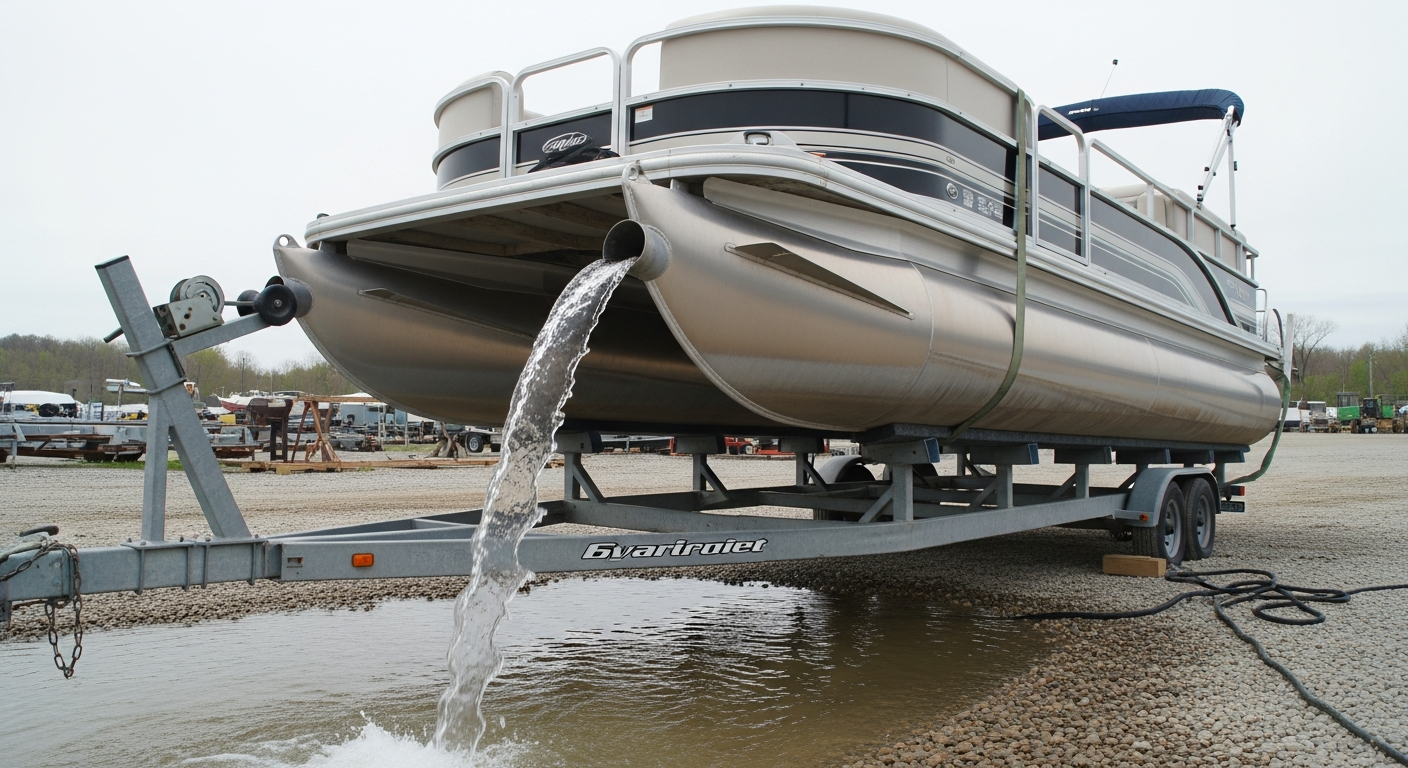
🔧 Fix the Swooshing Sound: How to Find and Repair Water in Your Pontoon Logs
That sloshing sound coming from underneath the deck when you rock the boat on the trailer is not your imagination. Water trapped inside pontoon logs is the #1 most expensive hidden defect in pontoon boats — costing $3,000–$10,000+ to repair depending on how long the water has been inside and how much damage it has caused.
The good news: diagnosing the problem takes less than 5 minutes. The fix ranges from a $15 drain plug replacement to a professional weld repair. This guide walks through exactly how to find the leak, how much water is inside, and whether the log can be saved — all sourced from real owner repairs documented on PontoonForums and Reddit.
🔍 The 30-Second Swooshing Sound Test
Before you do anything else, confirm whether you actually have water inside your logs:
- Pull the boat out of the water onto the trailer. Let it sit for 10 minutes so the logs stabilize.
- Stand beside the boat at the center of one log. Push the boat sideways — toward you and then away — in a rocking motion.
- Listen for sloshing. Water inside a log produces a distinct sloshing or swooshing sound, different from water on the deck surface. It sounds muffled and comes from inside the tube.
- Repeat for the other log(s). Tritoons have three tubes — check all of them.
⚡ Step 1: Drain the Water
Every pontoon log has one or two drain plugs at the stern — threaded brass or aluminum bungs at the lowest point of each tube. As one owner reported after discovering water pouring from the stern drain, catching this early makes all the difference. This is where you start.
- Raise the bow of the trailer so the stern tips downward. This moves all internal water toward the drain plugs. Use a trailer jack or park on a slope with the bow uphill.
- Place a bucket under each drain plug. You want to measure how much water comes out.
- Remove the drain plug slowly. If it is corroded in place, use penetrating oil (PB Blaster) and a socket wrench. Do not force it with pliers — you can strip the bung threads and create a bigger problem.
- Let the water drain completely. This can take 10–30 minutes depending on volume. A log with heavy water intrusion can hold 5–20+ gallons.
- Less than 1 gallon: Minor seep — likely a drain plug gasket or small tearaway pad crack. Easy fix.
- 1–5 gallons: Moderate leak — probably a failed weld seam or cracked tearaway pad. Repairable with welding.
- 5–20+ gallons: Major breach — possible structural weld failure. Professional inspection recommended before repair.
🔧 Step 2: Find the Leak Source
Once the water is drained, you need to find where it entered. There are four common leak points on pontoon logs, listed by frequency:
Leak Source #1: Drain plug failure
The most common and cheapest fix. The drain plug gasket deteriorates over time, or the plug itself was cross-threaded during reinstallation. Check the plug threads for damage, check the bung seat for corrosion, and inspect the gasket (if it has one). Replacement drain plugs cost $8–$15 and install in 2 minutes.
Leak Source #2: Tearaway pad cracks
Tearaway pads are small aluminum mounting plates welded to the outside of the log. Brackets, cross-members, and hardware bolt to these pads instead of directly to the log tube. Over time, the weld between the pad and the tube cracks from vibration stress — creating a path for water directly into the log interior.
How to find them: Crawl under the boat and inspect every pad-to-tube weld joint. Look for hairline cracks, separation between the pad edge and the tube surface, or discoloration where water has been seeping. For a detailed visual inspection guide, see our tearaway pad check walkthrough.
Leak Source #3: Weld seam failure
The longitudinal weld seam that runs the length of each log can develop porosity (tiny holes) or cracks over years of thermal cycling and vibration. These leaks are harder to find because they can be small enough to miss visually.
Leak Source #4: Nosecone impact damage
Hitting a submerged object — a stump, rock, or sandbar — can crack the nosecone weld or dent the cone enough to separate it from the main tube. Check the nosecone welds for cracks and the cone itself for dents that could have stressed the joint.
📊 Step 3: Pressure Test the Logs
If you cannot find the leak visually, a pressure test will reveal it. This is the same method marine surveyors use.
- Reinstall the drain plug(s) securely with new gaskets.
- Attach a low-pressure air source to one of the drain plug holes (using a tire valve adapter threaded into the bung hole). A bicycle pump works. Do NOT use a compressor at full pressure — pontoon logs are not pressure vessels. 5–10 PSI maximum.
- Pressurize the log to 3–5 PSI.
- Spray soapy water (dish soap and water in a spray bottle) along every weld seam, tearaway pad, drain plug, and nosecone joint.
- Watch for bubbles. Bubbles indicate the leak location. Mark each spot with a grease pencil or masking tape.
- Check the pressure gauge after 30 minutes. If the pressure holds steady, the log is sealed. If it drops, you have a leak that the soap test should have revealed.
🔧 Step 4: Repair Options by Leak Type
| Leak Source | DIY Fix | Pro Fix | Cost |
|---|---|---|---|
| Drain plug | Replace plug + gasket | Not needed | $8–$15 |
| Tearaway pad crack | Marine sealant (temporary) | TIG weld repair | $50–$300 |
| Weld seam porosity | Not recommended | TIG weld repair | $200–$600 |
| Nosecone crack | Not recommended | Weld + reinforce | $300–$800 |
| Major structural failure | Not possible | Log replacement | $3,000–$10,000+ |
A note about marine sealant as a "fix": Products like 3M 5200 and marine-grade silicone can seal a tearaway pad crack temporarily — sometimes lasting years on a freshwater boat. However, sealant does not restore structural integrity. If the pad is taking load from a cross-member or bracket, the crack will continue to grow behind the sealant. For anything beyond a drain plug, a TIG weld from a certified aluminum welder is the correct repair.
⚠️ When a Log Cannot Be Saved
Water that has been sitting inside a log for more than one season causes internal corrosion that you cannot see from the outside. Aluminum does not rust like steel, but it does corrode — especially when dissimilar metals are present (steel bolts in aluminum structures create galvanic corrosion cells in the presence of water).
Signs that the damage has gone too far:
- The log wall feels thin when you tap it — a dull thud instead of a metallic ring indicates wall thinning from internal corrosion
- White powder residue in the drained water — aluminum oxide, meaning the log walls are actively corroding
- Multiple leak sources along the same weld seam — indicates systemic weld degradation, not an isolated failure
- Visible deformation — a log that is bowed, sagging, or has soft spots cannot be reliably repaired
Log replacement costs $3,000–$10,000+ depending on length, diameter, and whether the boat needs to be transported to a facility with aluminum welding capability. On a used pontoon valued under $8,000, a log replacement often exceeds the boat's value — making it a walk-away situation.
🛡️ Preventing Water in Logs
Prevention is dramatically cheaper than repair. Add these to your seasonal routine:
- Check drain plugs every spring. Replace gaskets annually ($2 each). Carry a spare plug aboard.
- Inspect tearaway pad welds annually. A 10-minute crawl-under visual inspection catches cracks before they become leaks.
- Maintain sacrificial anodes. Replace zinc or magnesium anodes when they are 50% consumed. Missing anodes accelerate corrosion at every metal-to-metal joint on the logs.
- Keep the boat on a lift when not in use. Pontoons stored in the water full-time develop more corrosion than those lifted out between uses.
- Winterize properly. Drain plugs out, bow up, logs dry for winter storage. Water left inside logs over a freeze-thaw cycle will expand and crack welds.
If your boat is sitting low in the back, check for water in logs as a first step — as multiple owners in this Reddit thread confirm, added water weight in the stern logs is one of the most common causes.
📋 Want the Full 47-Point Inspection Checklist?
The Used Pontoon Inspection Toolkit covers log diagnosis plus 40 more checkpoints — with photo references for every defect type. Less than one hour of a marine surveyor's time.
Get the Inspection Toolkit — $19Printable. Works for buying used or as an annual maintenance audit.