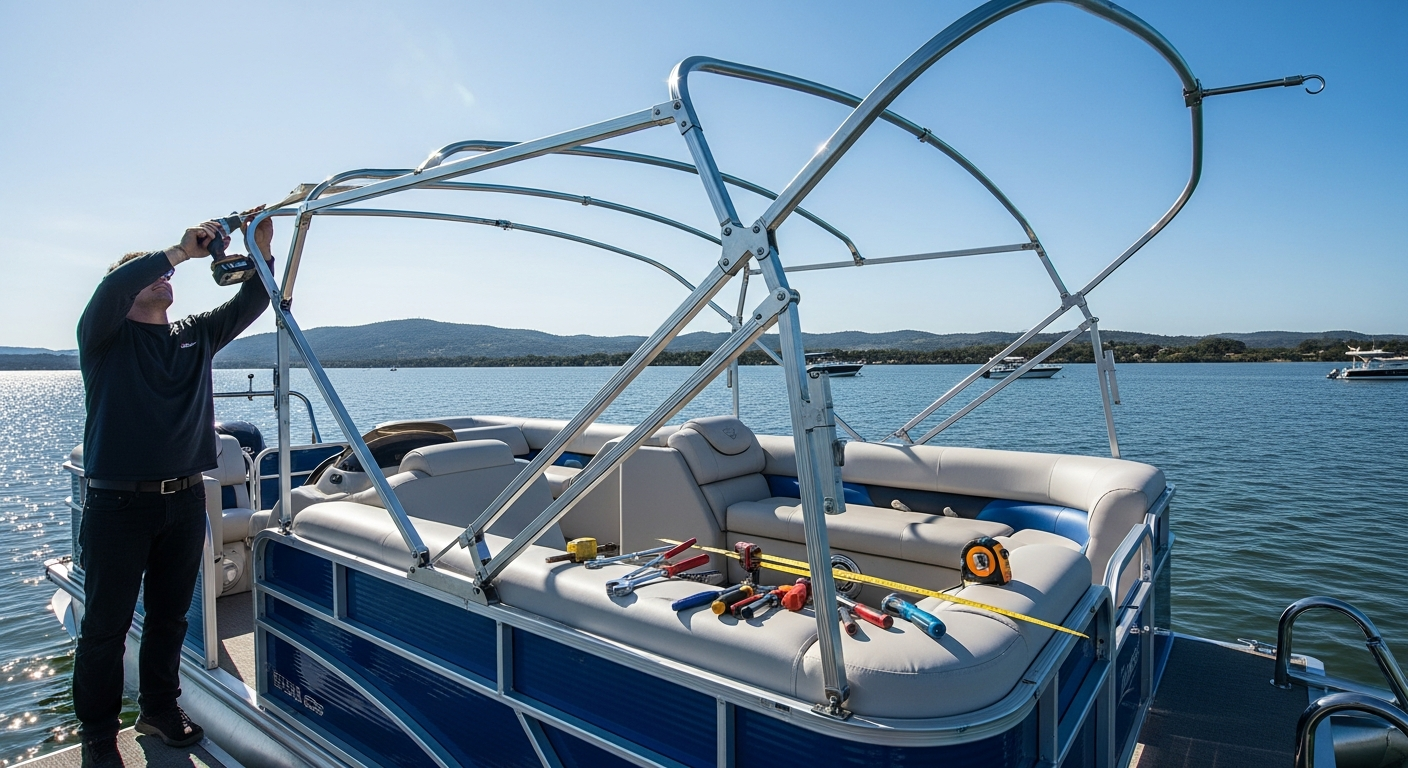
⭐ Amazon Bimini Top Stainless Upgrade: The $750 Swap That Ends Frame Corrosion
🎯 The Verdict
Best for: Owners of 3–8 year old pontoons whose original aluminum bimini frames are showing corrosion, pitting, or joint fatigue — and who want a permanent fix instead of another $200 Amazon replacement that fails in 18 months.
Not for: Owners with boats under warranty (your dealer should cover frame replacement), or anyone on a pontoon they plan to sell within a year (the upgrade will not return its cost at resale).
🔍 Why Your Amazon Bimini Failed
The most common complaint on PontoonForums and Reddit about aftermarket bimini tops is not the canvas — it is the frame. As owners have shared when asking about cheap bimini tops, budget aluminum frames from Amazon and eBay develop white oxidation pitting within 1–2 seasons, especially at joints and hinge points where water pools after rain.
Forum members call this the "buy twice, cry twice" cycle: buy a $180 bimini, watch the frame corrode by season two, throw it away, buy another $180 bimini, repeat. Community feedback on Amazon biminis confirms this pattern across dozens of owners. Three replacements later, you have spent more than a quality stainless frame would have cost from the start.
The root cause is simple. Budget bimini frames use 6061 aluminum tubing with thin anodizing that breaks down in saltwater, brackish lake conditions, and even freshwater environments where the boat sits uncovered between uses. The joints are riveted, not welded, creating crevices where moisture collects and accelerates corrosion.
📊 Stainless vs. Aluminum: The Real Comparison
| Factor | Budget Aluminum (Amazon) | 316 Stainless Steel |
|---|---|---|
| Price range | $150–$250 | $600–$900 |
| Lifespan (freshwater) | 2–4 seasons | 10–15+ years |
| Lifespan (saltwater) | 1–2 seasons | 8–12 years |
| Corrosion resistance | Pits at joints within 12–18 months | Virtually corrosion-proof |
| Weight | Lighter (12–18 lbs) | Heavier (18–28 lbs) |
| Cost per season (freshwater) | $50–$85/season | $50–$70/season |
| Joint construction | Riveted — water traps | Welded — sealed joints |
| Resale value added | None | $200–$400 perceived value |
The per-season cost comparison tells the real story. A $750 stainless frame that lasts 12 years costs roughly $63 per season. A $200 aluminum frame replaced every 3 years costs $67 per season — and that does not account for the installation time, the trips to return defective units, or the afternoon you spend on the water with no shade because the frame snapped at a hinge point mid-season. For context on how fabric quality affects the overall setup, Boating Magazine's fabric waterproofing testing data shows how much material choice matters for longevity.
⚠️ The "Marine Grade" Stainless Scam on Amazon
Not every stainless bimini on Amazon is worth buying. The platform is flooded with frames marketed as "marine grade stainless steel" that are actually 304 stainless — a grade that resists corrosion better than aluminum but is not rated for sustained marine exposure. True marine-grade stainless is 316 or 316L, which contains molybdenum for salt and chloride resistance.
How to tell the difference before you buy:
- Check the listing for "316" specifically. If it says "stainless steel" without a grade number, assume 304.
- Check the weight. A genuine 316 stainless 4-bow bimini frame for a 22–24 foot pontoon should weigh 22–28 lbs. If the listing claims stainless but weighs under 18 lbs, the tubing is likely thinner gauge or a different alloy.
- Read the 2-star reviews. Skip the 5-star reviews (often incentivized) and the 1-star reviews (often user error). The 2-star and 3-star reviews contain the real failure data — look for phrases like "rust spots after one season," "pitting at the hinges," or "not actually 316."
- Check the fittings separately. Some frames use 316 tubing but 304 fittings at the mounting points. The fittings fail first because they are in constant contact with the deck hardware.
🛒 What to Look for in a Stainless Bimini Frame
Based on owner forum discussions, the features that separate frames that last from frames that fail:
✅ Must-Have Features
- 316 or 316L stainless tubing — non-negotiable for marine use
- Welded joints — not riveted or press-fit, which trap moisture
- 1" OD tubing minimum — thinner tubing flexes in wind and weakens at stress points
- Integrated drainage — small drain holes at low points to prevent standing water
- Quick-release mounting hardware — for trailering and off-season storage
❌ Red Flags
- "Marine grade" without specifying 316 — marketing language that means nothing
- Riveted joints — corrosion starts here first, regardless of material
- No brand name or manufacturer info — generic white-label products with no warranty support
- Canvas sold separately with no sizing info — suggests the frame is an afterthought
- Suspiciously light weight — under 18 lbs for a 4-bow frame means thin-wall tubing
🔧 Installation: What Forum Members Wish They Had Known
Most stainless bimini frames use the same mounting footprint as the factory aluminum frame — but there are three things that catch first-time installers:
- Existing bolt holes may not line up perfectly. Stainless frames from different manufacturers use slightly different center-to-center measurements on the deck mounts. Measure your existing bolt pattern before ordering. Most pontoons use a 4-bolt square pattern with 3.5" or 4" spacing.
- Stainless is heavier — check your mounting hardware. If your original aluminum frame was bolted through a fiberglass console cap, the extra 10–15 lbs of a stainless frame may require backing plates (stainless washers with fender backing) to distribute load and prevent cracking.
- Use anti-seize compound on all stainless-to-stainless connections. Without it, stainless fasteners in stainless fittings will gall (cold-weld) and become permanently locked. A $4 tube of anti-seize prevents a $200 problem.
💡 The Bottom Line
A stainless bimini frame is a "buy once, cry once" upgrade — the kind of purchase where spending more upfront saves money over the life of the boat. The math works out to roughly the same per-season cost as cheap aluminum replacements, with the added benefit of never having to install another bimini frame on a hot boat ramp.
The key is buying genuine 316 stainless with welded joints — not the repackaged 304 imports that Amazon's algorithm pushes to the top of search results. Check the grade, check the weight, read the 2-star reviews, and verify the fittings match the frame material.
For more gear that passes the "buy once, cry once" test, see the full handy hints and gadgets directory. For keeping your current top looking good while you decide, check our pontoon cleaner comparison and visual cover guide.
Affiliate link — PontoonHQ may earn a commission at no cost to you.