⚠️ Stop Your Pontoon From Fuel Burping: Vent Line Diagnosis and Fix
You pull up to the gas dock, start filling the tank, and fuel splashes back up the fill neck — soaking the deck, your shoes, and the dock. Forum members call this "fuel burping" and it is one of the most common frustrations on pontoon boats, especially models from the mid-2000s through early 2010s.
Fuel burping is not just messy — it is a safety issue. Gasoline on a hot deck near an engine compartment creates a fire risk, and spilled fuel in a marina can result in environmental fines. The fix is almost always a vent line problem, as owners troubleshooting fuel line setups on Reddit consistently confirm, and in most cases it costs under $50 in parts.
🔍 Why Pontoon Fuel Tanks Burp
Every marine fuel tank has two openings at the top: the fill neck (where you pump fuel in) and the vent line (where displaced air escapes as fuel enters). When the vent line is blocked, kinked, or too small, the air inside the tank has nowhere to go — so it pushes back up through the fill neck, bringing fuel with it.
Think of it like pouring water into a bottle with your thumb over the opening. The air has to go somewhere.
The 4 most common causes
The vent line runs from the top of the tank to a through-hull fitting on the side of the boat. On pontoons, this hose often routes through tight spaces under the deck where furniture bases, storage compartments, or aftermarket wiring installations can pinch it flat. A kink anywhere along the line restricts airflow enough to cause burping.
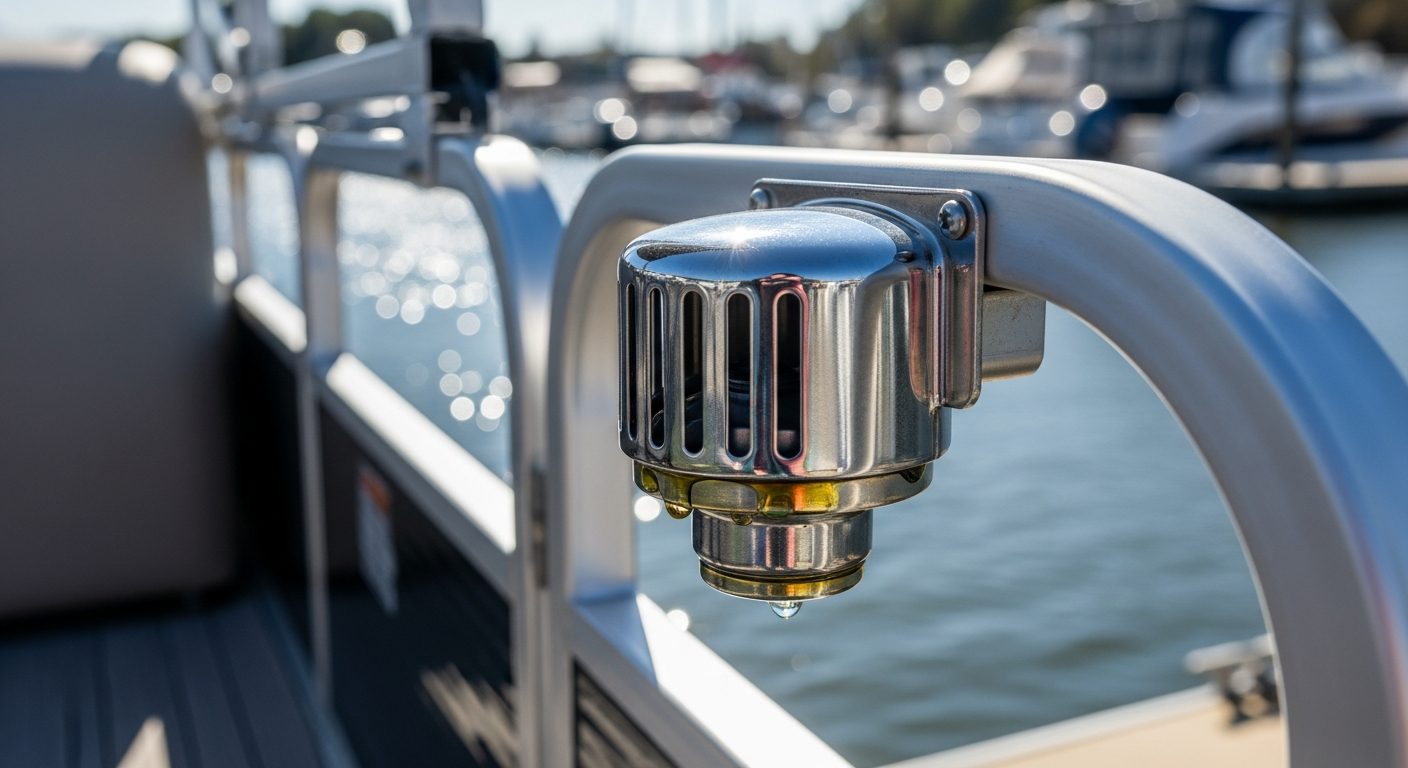
The external vent fitting — the small screen-covered port on the hull side — clogs with spider webs, mud dauber nests, and debris. Boats stored on trailers between uses are especially prone to insect nesting in the vent during off-season storage. A single mud dauber nest can completely block airflow.
EPA-compliant fuel systems (required on boats manufactured after 2010) include an anti-siphon valve in the vent line to prevent fuel vapor from escaping to the atmosphere. When these valves stick closed — which they do, regularly — the tank cannot vent at all. This is the #1 cause of fuel burping on newer pontoons.
Some manufacturers used 9/16" vent hose on tanks that need 5/8" — especially on larger fuel tanks (30+ gallons). The smaller hose cannot move air fast enough when fuel is pumped in at standard dock pump rates (5–8 gallons per minute). The solution is upgrading to 5/8" hose and fittings.
🔧 Step-by-Step Diagnosis
Work through these checks in order. Most fuel burping problems are solved by Step 1 or Step 2.
Step 1: Check the external vent fitting
Find the vent fitting on the hull side — usually a small round port with a screen, located near the waterline on the starboard side. Blow through it from outside the boat. You should feel air moving freely with minimal resistance. If air does not pass, the fitting or the line immediately behind it is blocked.
Fix: Remove the fitting (two screws on most models). Clean the screen with a small brush. Use compressed air or a pipe cleaner to clear the first 6 inches of hose behind the fitting. Reinstall.
Step 2: Inspect the vent hose for kinks
Trace the vent hose from the tank fitting to the hull fitting. On most pontoons, this requires removing an access panel or lifting seat bases to follow the routing. Look for:
- Sharp bends (especially where the hose exits the tank or passes through bulkheads)
- Compression from stored gear, batteries, or aftermarket equipment sitting on the hose
- Hose that has hardened and collapsed at a bend (common with older rubber hose exposed to ethanol fuel vapors)
Fix: Reroute the hose to eliminate kinks. Replace hardened or collapsed hose sections with new USCG Type A1 or A2 fuel vent hose (not generic garden hose or automotive fuel line — these are not rated for marine fuel vapor exposure). Use smooth-radius 90° elbows at turns instead of forcing the hose into sharp bends.
Step 3: Test the anti-siphon valve
If your boat has an EPA-compliant fuel system (2010+), there is an anti-siphon valve inline in the vent hose, usually near the tank. Disconnect the vent hose at the valve and blow through each side separately:
- Air should pass freely from the tank side toward the hull fitting (this is the direction displaced air travels during fueling)
- Air should be blocked from the hull side toward the tank (this prevents fuel vapor from venting to atmosphere)
If air does not pass in the tank-to-hull direction, the valve is stuck closed.
Fix: Replace the valve. They cost $12–$25 and are inline push-to-connect fittings on most models. For additional technical discussion on fuel system components, the PontoonForums maintenance section has extensive troubleshooting threads. Do NOT simply remove the valve and leave the line open — this voids EPA compliance and allows fuel vapor to escape continuously, which is both an environmental and fire hazard.
Step 4: Check vent hose diameter
Measure the inside diameter of your vent hose. If your tank is 25 gallons or larger and the hose is 9/16" ID, upgrading to 5/8" ID hose and a matching hull fitting will solve flow-rate burping that occurs only when filling at full pump speed.
Quick test: If the burping only happens when the dock pump is running at full speed, but the tank fills normally at reduced flow, the vent line is undersized — not blocked.
📊 Fuel Burping Quick-Reference
| Symptom | Likely Cause | Fix | Cost |
|---|---|---|---|
| Burps immediately when filling starts | Fully blocked vent (fitting or valve) | Clean fitting or replace anti-siphon valve | $0–$25 |
| Burps only at full pump speed | Undersized vent hose or partial kink | Upgrade to 5/8" hose or reroute | $15–$40 |
| Burps when tank is nearly full | Normal — tank is full | Slow down pump rate near full | $0 |
| Burps inconsistently (hot days worse) | Fuel vapor expansion + marginal vent | Check all vent components + replace hose | $20–$50 |
| Fuel smell from vent but no burping | Failed anti-siphon valve (stuck open) | Replace anti-siphon valve | $12–$25 |
⚡ Parts You Need
For a complete vent system refresh — which solves fuel burping permanently — you need:
- USCG Type A1 fuel vent hose, 5/8" ID — 6–10 feet depending on routing ($15–$25)
- Stainless steel hose clamps — 2–4 clamps, 5/8" size ($5)
- Replacement anti-siphon valve — if your boat has EPA-compliant system ($12–$25)
- Replacement hull vent fitting — if the old one is corroded or the screen is damaged ($8–$15)
- Marine sealant for the hull fitting bedding — recommended sealant ($8–$12)
Total cost for a complete vent system refresh: $35–$80. Time: 1–2 hours.
🛡️ Prevention
- Check the vent fitting screen every spring before the first fill-up. Ten seconds with a flashlight saves a fuel-soaked dock.
- Stuff a small piece of foam into the vent fitting during winter storage to block insect nesting — remove it before the first fill of the season. (Set a reminder. Filling a tank with a foam-blocked vent is an instant burp.)
- Replace rubber vent hose every 8–10 years. Ethanol fuel vapors degrade rubber from the inside, causing it to swell and collapse at bends even when the outside looks fine. Maintenance crossover issues like drain plug deterioration follow a similar replacement schedule.
- Fill slowly for the last 20%. Even a perfectly vented system will burp if you jam a dock pump at full rate into an almost-full tank. Slow down when the gauge reads three-quarters.
Related Problems
Fuel system issues often overlap with electrical problems — aftermarket wiring routed near fuel lines is a common hazard on older pontoons. If you are chasing fuel problems and notice wiring that does not look factory, see our wiring rats' nest guide before working near fuel components.
For a complete seasonal maintenance checklist that includes fuel system checks alongside all other spring commissioning tasks, see our dedicated guide. For marine-grade replacement hoses, sealants, and fuel system parts, see the pontoon gadgets directory.