Lowe Pontoon Boats: Complete Owner-Sourced Brand Profile
Owner Verdict at a Glance
- Owner Rating: 7.2 / 10
- Build Quality Score: 6.8 / 10
- Tier: Entry
- Price Range: $16,000 -- $50,000
- Parent Company: Brunswick Corporation
- Best For: Fishing-focused buyers who prioritize function over luxury
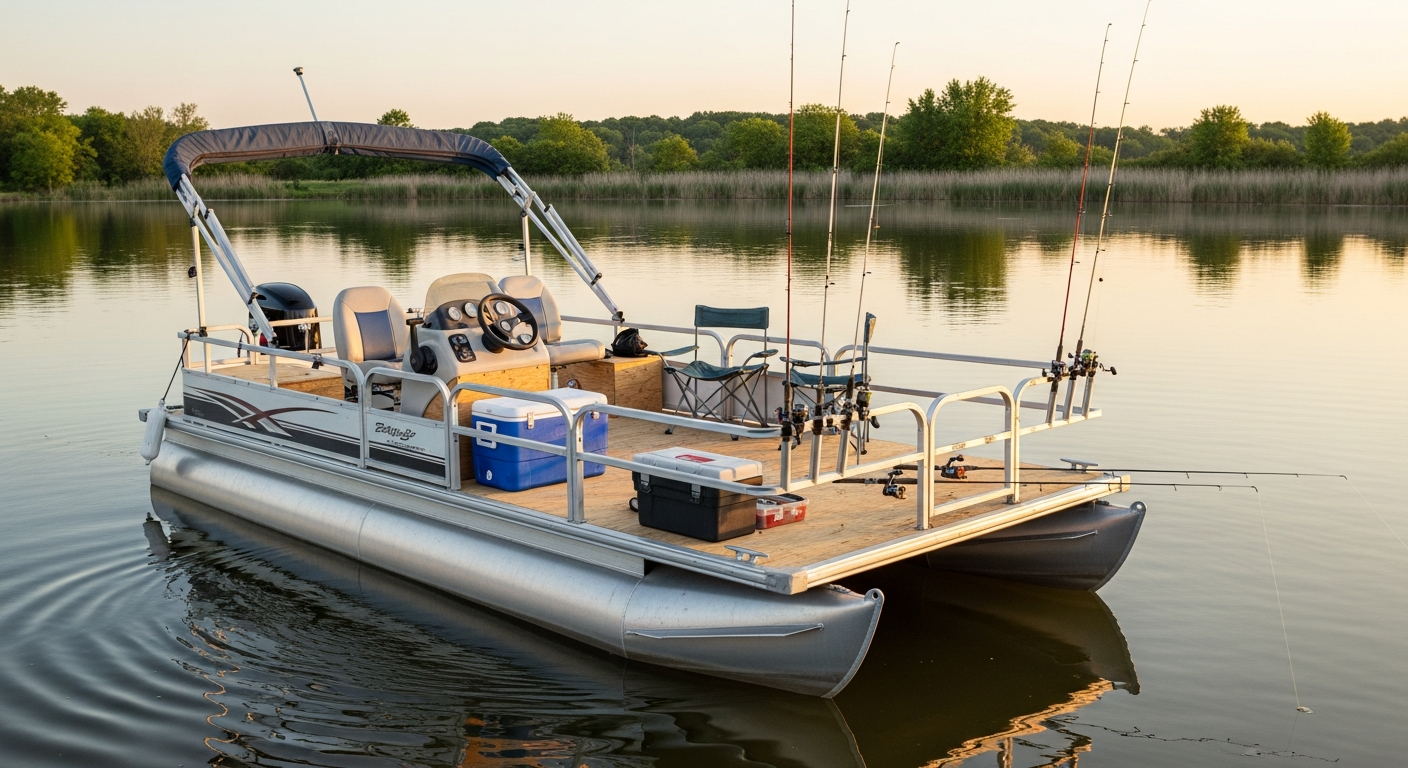
Lowe Boats has been building aluminum vessels since 1971, and that heritage shows in how the company approaches pontoon design. Where most entry-level brands optimize for family cruising and leisure, Lowe builds pontoons with anglers in mind first. Standard livewells, factory-installed rod holders, and trolling motor pre-wiring come on models where competitors charge extra or do not offer them at all.
That fishing-first philosophy makes Lowe a standout in the entry-level segment -- not because it builds the flashiest boat, but because it delivers the most fishing-ready pontoon for the money. Forum discussions across Pontoon Forum, Walleye Central, and bass fishing communities consistently point to Lowe as the brand that gives anglers genuine fishing capability without forcing them into a $60,000+ mid-tier package.
What Lowe Is Known For
Lowe's defining strength is fishing-specific features included as standard equipment. The SF (Sport Fish) series comes with aerated livewells, molded rod holders, trolling motor mounts, and fish-finder pre-wiring on models that start well under $30,000. Competing brands at the same price point either omit these features entirely or list them as dealer-installed options that inflate the final cost.
The aluminum construction reflects Lowe's half-century of experience building jon boats, bass boats, and utility craft. The hull welds are clean and consistent, and owners frequently note that the under-deck construction -- crossmembers, riser brackets, and tube attachments -- shows more attention to detail than you might expect at this price point. The Boating Magazine pontoon buyer's guide highlights construction quality as one of the key differentiators between entry-level brands, and Lowe consistently scores above its price class on this metric. Lowe does not cut as many structural corners as Sun Tracker, even though both brands occupy the entry tier.
Parts availability is solid. As a Brunswick-owned brand, Lowe benefits from the same supply chain that supports Mercury Marine, Boston Whaler, and other major Brunswick properties. Replacement hardware, electrical components, and furniture pieces are generally in stock at authorized dealers.
Lowe also maintains a dedicated dealer network separate from the big-box retail model. While the network is smaller than Sun Tracker's Bass Pro footprint, Lowe dealers tend to be independent marine specialists who provide more hands-on service during the buying and warranty process.
Common Complaints and Documented Issues
The most common complaint about Lowe pontoons centers on furniture durability -- specifically on the budget Ultra and base SS models. The vinyl seating holds up adequately in moderate climates, but owners in high-UV states report stitching failure and vinyl cracking within three to four seasons. The foam cushion density is comparable to Sun Tracker: functional but noticeably thinner than what mid-tier brands offer.
Carpet quality on the lower-priced models draws the same criticism that follows most entry-level pontoons. The marine carpet fades, mats, and retains moisture in ways that woven vinyl flooring does not. Owners who upgrade to snap-in woven vinyl report a dramatic improvement in both aesthetics and maintenance.
Hardware quality on the Ultra series is a mixed bag. Gate latches, cup holder inserts, and smaller fittings feel lighter than what you find on the Retreat or SF lines. Several forum members describe a noticeable step up in hardware feel once you move from the Ultra to the SS or SF models -- suggesting that Lowe reserves its better components for mid-line and above.
A smaller but recurring complaint involves trailer quality on package deals. Some owners report that the trailers bundled with entry-level Lowe packages use lighter axles and smaller wheel bearings than what the boat's loaded weight really demands. Bearing failures and tire issues on the stock trailer appear in enough threads to be worth noting.
Model Lineup Overview
Lowe organizes its pontoon lineup into four series, each serving a distinct buyer profile:
Ultra
The Ultra is Lowe's entry point -- the most affordable way into a Lowe pontoon. Available in 160, 180, and 200 configurations, the Ultra targets casual lake use and light family cruising. Features are basic: standard seating, a Bimini top, and essential safety equipment. The Ultra is where Lowe competes most directly with Sun Tracker's Bass Buggy and Party Barge on price.
SS (Sport Series)
The SS models step up in both size and standard features. Available from 19 to 23 feet, the SS adds upgraded furniture, a better stereo package, and improved storage layouts. The SS is Lowe's volume leader for family buyers and represents the best balance of price and features in the lineup. It sits in the $25,000--$40,000 range depending on length and motor package.
SF (Sport Fish)
The SF series is where Lowe separates itself from the entry-level competition. Built specifically for anglers, the SF comes standard with aerated livewells, multiple rod holders, a trolling motor mount with pre-wiring, and a fishing-friendly deck layout that provides 360-degree casting access. Available in 18-foot to 23-foot lengths, the SF is the pontoon you buy when fishing is the primary mission and family comfort is secondary.
Retreat
The Retreat is Lowe's premium offering and the only series that pushes into mid-tier pricing territory. Available in larger lengths with upgraded furniture, premium vinyl flooring, and enhanced stereo systems, the Retreat targets buyers who want Lowe's construction quality with a more refined on-water experience. Pricing on the Retreat can approach $50,000, putting it in competition with entry-level models from Crest and Harris.
Tritoon Options
Tritoon availability in the Lowe lineup is limited, mainly offered on larger SS and Retreat models. The SF fishing series does not offer a tritoon configuration, which makes sense given that most SF buyers are running moderate horsepower for fishing applications rather than the 200+ HP setups that benefit most from a third tube.
Buyers who specifically want a tritoon for rough-water stability, higher top speeds, or wake sports will find a broader selection from brands like Bennington, Harris, and Crest. Lowe's tritoon offerings exist, but they are not the brand's strength.
Price Range and Value Position
Lowe pricing starts as low as $16,000 for a base Ultra package and extends to approximately $50,000 for a loaded Retreat with a larger motor. The fishing-focused SF series falls in the $22,000--$38,000 range -- a segment where Lowe's standard fishing features deliver more value than any competitor at the same price.
Resale value tracks slightly above Sun Tracker but below mid-tier brands like Crest and Harris. According to iBoats market listings, a well-maintained five-year-old Lowe typically sells for 45--55% of its original MSRP. The fishing models tend to hold value a bit better than the cruising models because demand for fishing-capable pontoons stays consistent in the used market.
The strongest value proposition in the entire Lowe lineup is the SF series at the $25,000--$35,000 price point. Buyers who want a pontoon primarily for fishing and secondarily for family use will struggle to find a better equipped boat for the money anywhere in the market.
Who Lowe Is Best For
- Fishing-focused buyers who want livewells, rod holders, and trolling motor mounts included as standard equipment without paying mid-tier prices.
- Dual-purpose owners who split their time between fishing and family cruising and need one boat that handles both reasonably well.
- Budget-conscious anglers who have been considering a bass boat but want the deck space and passenger capacity of a pontoon.
- Buyers who value function over aesthetics and would rather have a well-equipped boat with basic finishes than a pretty boat with no fishing features.
Who Should Look Elsewhere
- Luxury-focused buyers. The furniture quality and interior finish on Lowe pontoons trail Harris, Bennington, and Barletta by a visible margin. Buyers who care about premium upholstery, ambient lighting, and high-end sound systems should shop those brands instead.
- Tritoon shoppers. The limited tritoon selection means Lowe is not the right starting point for buyers who need three-tube performance.
- High-resale buyers. While Lowe holds value better than Sun Tracker, the depreciation curve still favors mid-tier and premium brands over the long term.
- Buyers in high-UV climates who are considering the base Ultra models -- the carpet and furniture on those entry-level packages will degrade faster than you want.
Forum Sentiment Summary
Forum sentiment around Lowe is noticeably warmer than what you see for Sun Tracker, even though both brands occupy the same entry tier. The difference comes down to perceived intent: owners view Lowe as a brand that builds a genuinely useful boat with real fishing features, rather than a brand that simply builds the cheapest boat possible.
The SF series generates the most positive discussion, with owners sharing experiences on Reddit's r/Pontoons and other communities. Anglers who switched from bass boats or aluminum fishing boats to an SF-series Lowe pontoon frequently post about how much they appreciate having a stable fishing platform that also carries their family comfortably. The standard livewell and rod holder package draws consistent praise.
Negative posts focus on the Ultra series and the furniture/carpet quality gap between the base models and the SS or Retreat lines. Several owners recommend skipping the Ultra entirely and starting with at least an SS if the budget allows. The general consensus is that Lowe's construction quality deserves a better interior than the Ultra series provides.
Overall, Lowe earns respect in the forums as a no-nonsense brand that delivers fishing functionality at entry-level prices. The brand does not pretend to be something it is not, and owners appreciate the honesty of the value proposition.
Further Reading
See how Lowe stacks up against every other brand in our Pontoon Brand Comparison Matrix. If you are evaluating motor packages on any Lowe model, run the numbers through our Universal Propping Chart to confirm the horsepower-to-weight ratio before you sign.